Payroll Discrepancy Resolution
Fix Payroll Errors Before They Hit
Use StackOne to connect your AI agent to your HRIS, payroll, and messaging tools to automate payroll discrepancy resolution.




AI Agents
Connect
MCP and A2A to REST, SOAP, and proprietary APIs.
Optimize
Tool discovery, data shaping, and reliable execution.
Secure
Scoped permissions, audit trails, and observability.
StackOne Integration Layer


 StackOne Integration Layer
Connect
200+ connectors, build your own, and multi-protocol support.
Optimize
Context, token, and speed optimization infrastructure.
Secure
Permissions API and prompt injection protection.
What Can AI Agents Do for Payroll Discrepancy Resolution?
Your agent audits compensation data across HRIS and payroll systems, flags mismatches, recommends corrections, and routes approvals before payroll runs close.
Classify Discrepancies
Flag mismatches by type — salary rate error, missing deduction, tax withholding mismatch — and severity. Cross-reference HRIS change logs to identify root causes for each discrepancy.
Recommend Corrections
Generate a remediation for each discrepancy with supporting data: update the payroll record, correct the HRIS entry, or escalate to a human approver based on type and monetary threshold.
Route for Approval
Send correction requests to the appropriate approver via Jira or ServiceNow based on discrepancy type and monetary threshold. Apply approved corrections back to the HRIS.
Notify Stakeholders
Alert payroll and HR leadership via Slack or Microsoft Teams with a summary of discrepancies found, corrections applied, and items pending approval.
Log & Report
Record every discrepancy, correction, and approval for audit. Generate a full reconciliation report with historical metrics for continuous improvement and compliance.
Extract & Compare Compensation Data
Pull salary rates, deductions, tax withholdings, and employment status from Workday, Rippling, or Gusto and compare against pending payroll records field by field.
Classify Discrepancies
Flag mismatches by type — salary rate error, missing deduction, tax withholding mismatch — and severity. Cross-reference HRIS change logs to identify root causes for each discrepancy.
Recommend Corrections
Generate a remediation for each discrepancy with supporting data: update the payroll record, correct the HRIS entry, or escalate to a human approver based on type and monetary threshold.
Route for Approval
Send correction requests to the appropriate approver via Jira or ServiceNow based on discrepancy type and monetary threshold. Apply approved corrections back to the HRIS.
Notify Stakeholders
Alert payroll and HR leadership via Slack or Microsoft Teams with a summary of discrepancies found, corrections applied, and items pending approval.
Log & Report
Record every discrepancy, correction, and approval for audit. Generate a full reconciliation report with historical metrics for continuous improvement and compliance.
Why Building a Good Payroll Reconciliation Agent Is Hard
Connecting to 10+ HRIS and Payroll Providers
A payroll reconciliation agent needs connectors to Workday, Rippling, Gusto, BambooHR, Personio, and HiBob — each with different auth models, pagination schemes, and rate limits. Building and maintaining that connector layer is a massive engineering lift before the agent even starts comparing records.
Multi-Tenant Auth Across HR Providers
Each customer's HRIS requires its own OAuth flow, token refresh cycle, and credential storage. Multiply that across dozens of providers and hundreds of tenants, and teams spend engineering months on auth plumbing instead of agent logic.
Employee Disputes Carry Prompt Injection Risk
Agents processing employee-submitted pay disputes ingest untrusted text. Fields like 'reason for dispute' can contain adversarial instructions that manipulate agent behavior on sensitive compensation records — a risk that grows with every dispute the agent handles.
Token Cost Grows with Payroll Volume
Without search-first architecture, the agent pre-loads every HRIS and payroll action definition into its context window. At thousands of employees per payroll cycle, that burns tokens on irrelevant tools before the agent even starts reconciling records.
How StackOne Makes Payroll Reconciliation Agents Possible
Everything your payroll agent needs to reconcile HRIS and payroll data, route corrections, and generate audit trails — with the controls compliance demands.
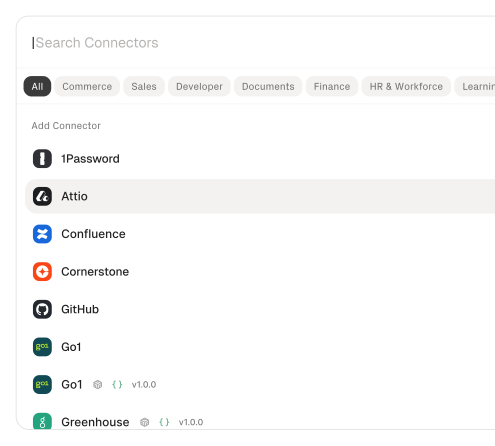
200+ connectors with 10K+ agent-optimized actions
Pre-built HRIS connectors for Workday, Rippling, Gusto, BambooHR, Personio, and HiBob with full native payroll actions mapped for agents — plus Jira, ServiceNow, Slack, and Microsoft Teams for routing and notifications.
Managed Auth handles credentials across providers
OAuth flows, API keys, and token refresh managed per tenant for every connected HRIS — agents never touch raw credentials.
Search and execute finds the right action
Agent searches StackOne's action catalog by natural language and executes the matching HRIS or payroll action — no pre-loading thousands of tool definitions.
Managed Webhooks keep compensation data current
StackOne subscribes to compensation change events across connected HRIS platforms, handling registration, retries, and delivery differences so the agent reconciles the latest records.
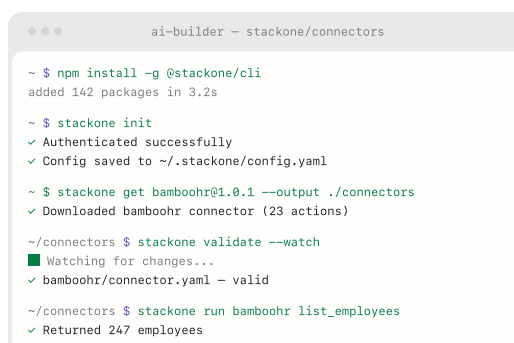
Connector Studio extends to any system
Build custom connectors for unsupported payroll platforms or internal approval systems via REST, SOAP, or GraphQL — no waiting on vendor support.
Defender blocks prompt injection from dispute text
StackOne Defender screens employee-submitted dispute text for injection attempts before the agent processes it, preventing adversarial content from manipulating payroll correction behavior.
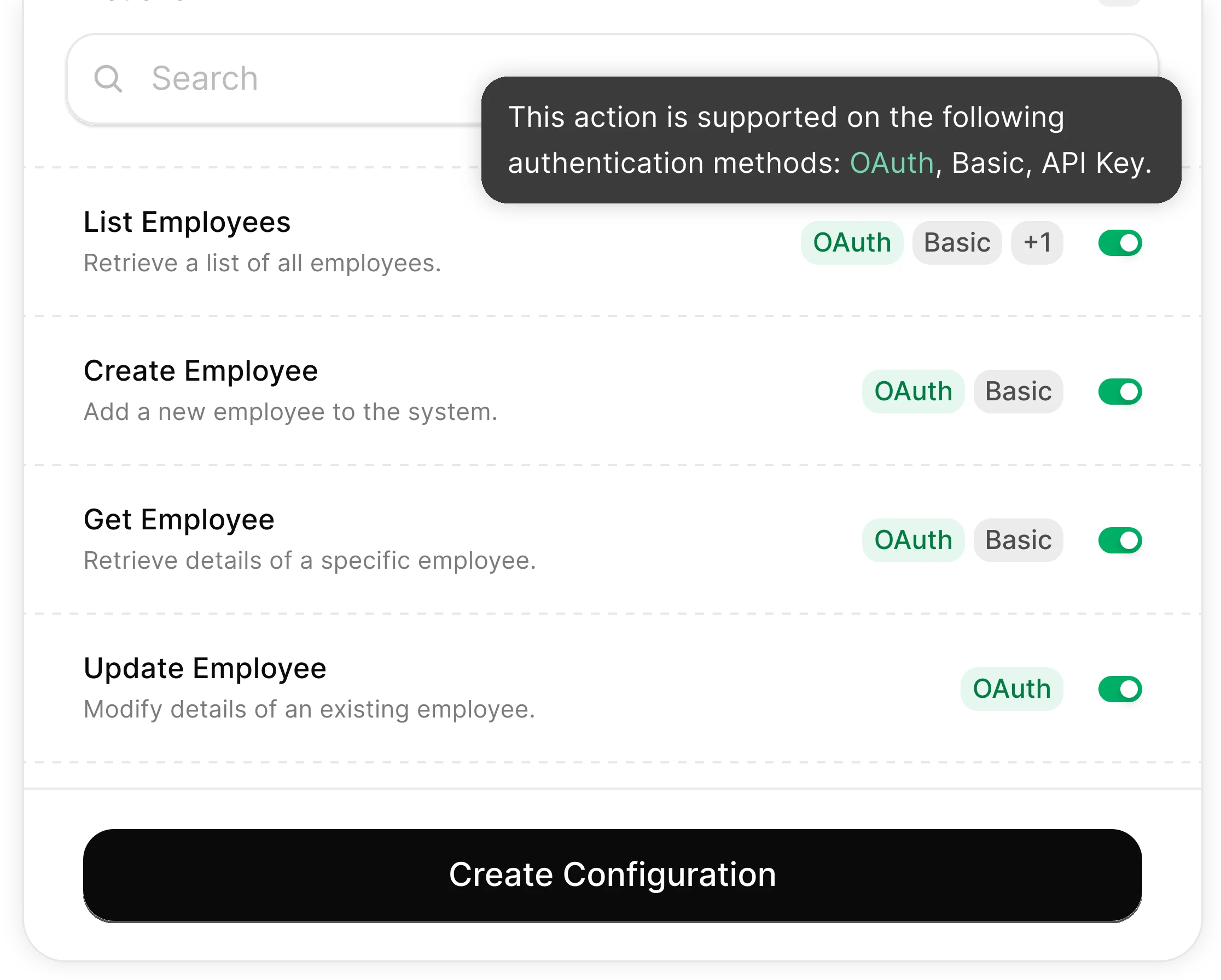
You Control What the Agent Can Do
Scoped permissions define exactly which compensation fields the agent reads and which correction actions it can trigger. Full audit trail of every operation for SOC 2 and internal audit compliance.
Connect Any Agent to Automate Payroll Reconciliation

Any Agent Framework
Claude, OpenAI, LangChain, Vercel AI SDK, CrewAI, Pydantic AI — StackOne works with every major agent framework out of the box.


Any Agent Builder
Whether you're building with code, a visual builder, or an enterprise platform — StackOne provides the integration layer your agent needs.
Connect Your Agent to Your HR & Payroll Stack
Start building in minutes. MCP connectors to every system your agent needs.
Frequently Asked Questions
Connect Your Agent to Your HR & Payroll Stack
Start building in minutes. MCP connectors to every system your agent needs.