AI Campaign Reports
Reports That Write Themselves
Use StackOne to connect your AI agent to your marketing automation, email, and analytics platforms to automate campaign performance reporting.




AI Agents
Connect
MCP and A2A to REST, SOAP, and proprietary APIs.
Optimize
Tool discovery, data shaping, and reliable execution.
Secure
Scoped permissions, audit trails, and observability.
StackOne Integration Layer


 StackOne Integration Layer
Connect
200+ connectors, build your own, and multi-protocol support.
Optimize
Context, token, and speed optimization infrastructure.
Secure
Permissions API and prompt injection protection.
What Can AI Agents Do for Campaign Performance Reports?
Your agent handles the full reporting pipeline — from data collection to stakeholder delivery — pulling metrics from every marketing channel along the way.
Trigger on Schedule or Demand
Workflow fires on a weekly cadence or via an on-demand request from a stakeholder. No manual kickoff required.
Pull Metrics from Every Channel
Authenticate and pull raw performance data from HubSpot, Salesforce, Mailchimp, Klaviyo, and ActiveCampaign for the specified date range.
Normalize and Aggregate
Map platform-specific metric names to a standard schema. Calculate cross-channel totals and derived KPIs — blended CPA, open rate, click rate, and week-over-week deltas.
Populate the Report
Write compiled data into a pre-built Google Sheets template and generate an executive summary highlighting top channels and anomalies.
Archive and Audit
Log the report run — timestamp, date range, channels covered, and recipients — for compliance and audit purposes. Full traceability on every delivery.
Trigger on Schedule or Demand
Workflow fires on a weekly cadence or via an on-demand request from a stakeholder. No manual kickoff required.
Pull Metrics from Every Channel
Authenticate and pull raw performance data from HubSpot, Salesforce, Mailchimp, Klaviyo, and ActiveCampaign for the specified date range.
Normalize and Aggregate
Map platform-specific metric names to a standard schema. Calculate cross-channel totals and derived KPIs — blended CPA, open rate, click rate, and week-over-week deltas.
Populate the Report
Write compiled data into a pre-built Google Sheets template and generate an executive summary highlighting top channels and anomalies.
Distribute to Stakeholders
Send the finished report via Gmail and post a summary with dashboard link to Slack. Every recipient gets the right format.
Archive and Audit
Log the report run — timestamp, date range, channels covered, and recipients — for compliance and audit purposes. Full traceability on every delivery.
Why Building a Good Reporting AI Agent Is Hard
Connecting to 10+ Marketing and Analytics Providers
A reporting agent needs to pull email metrics from Mailchimp or Klaviyo, campaign data from HubSpot or ActiveCampaign, and traffic from GA4 — each with its own OAuth flow, pagination scheme, and rate limits. Building and maintaining connectors for each is a massive lift.
Token Cost Grows with Campaign Volume
Without search-first architecture, the agent pre-loads every marketing platform action definition before pulling a single metric. Running reports across dozens of campaigns and multiple platforms burns tokens on irrelevant tools every time.
Campaign Data Carries Prompt Injection Risk
Report agents ingest email subject lines, ad copy, and UTM parameters written by anyone in the organization. Adversarial instructions hidden in campaign metadata can hijack the agent during report compilation — distorting numbers or leaking cross-campaign data.
Getting High Accuracy Requires Purpose-Built Tools
Compiling accurate reports means pulling opens, clicks, conversions, and spend from different systems with different metric definitions. Raw marketing API wrappers expose too many low-level details and lead to hallucinated attribution data.
How StackOne Makes Reporting AI Agents Possible
Everything your reporting agent needs to pull metrics, compile dashboards, and distribute reports — with the controls IT demands.
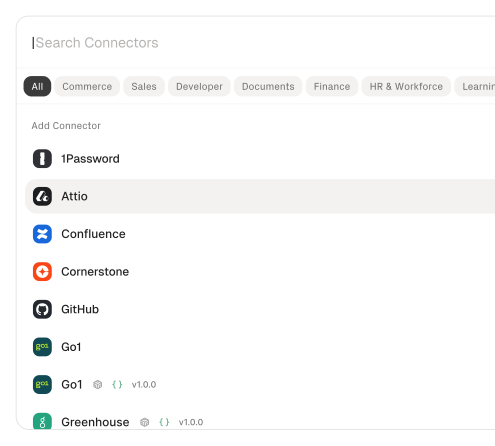
200+ connectors with 10K+ agent-optimized actions
Pre-built connectors for HubSpot, Salesforce, Mailchimp, Klaviyo, ActiveCampaign, and GA4 with full native action coverage per provider.
Managed Auth handles credentials across providers
OAuth flows, API keys, and token refresh managed per tenant for every connected marketing platform — no custom auth code.
Search and execute finds the right action
Agent searches StackOne's catalog by natural language and executes the matching marketing or CRM action — no pre-loading tool definitions.
Managed Webhooks deliver campaign events consistently
Event-driven triggers from marketing platforms without building polling infrastructure. StackOne handles retries, rate limits, and delivery across providers.
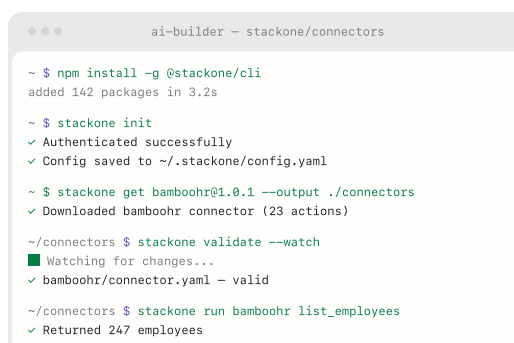
Connector Studio extends to any marketing platform
Build custom connectors for unsupported marketing tools via REST, SOAP, or GraphQL using a YAML framework — no waiting on vendor support.
Defender blocks prompt injection from campaign data
Campaign content from CRMs and email platforms contains user-generated text. Defender screens every external data field before it reaches the agent, neutralizing hidden payloads.
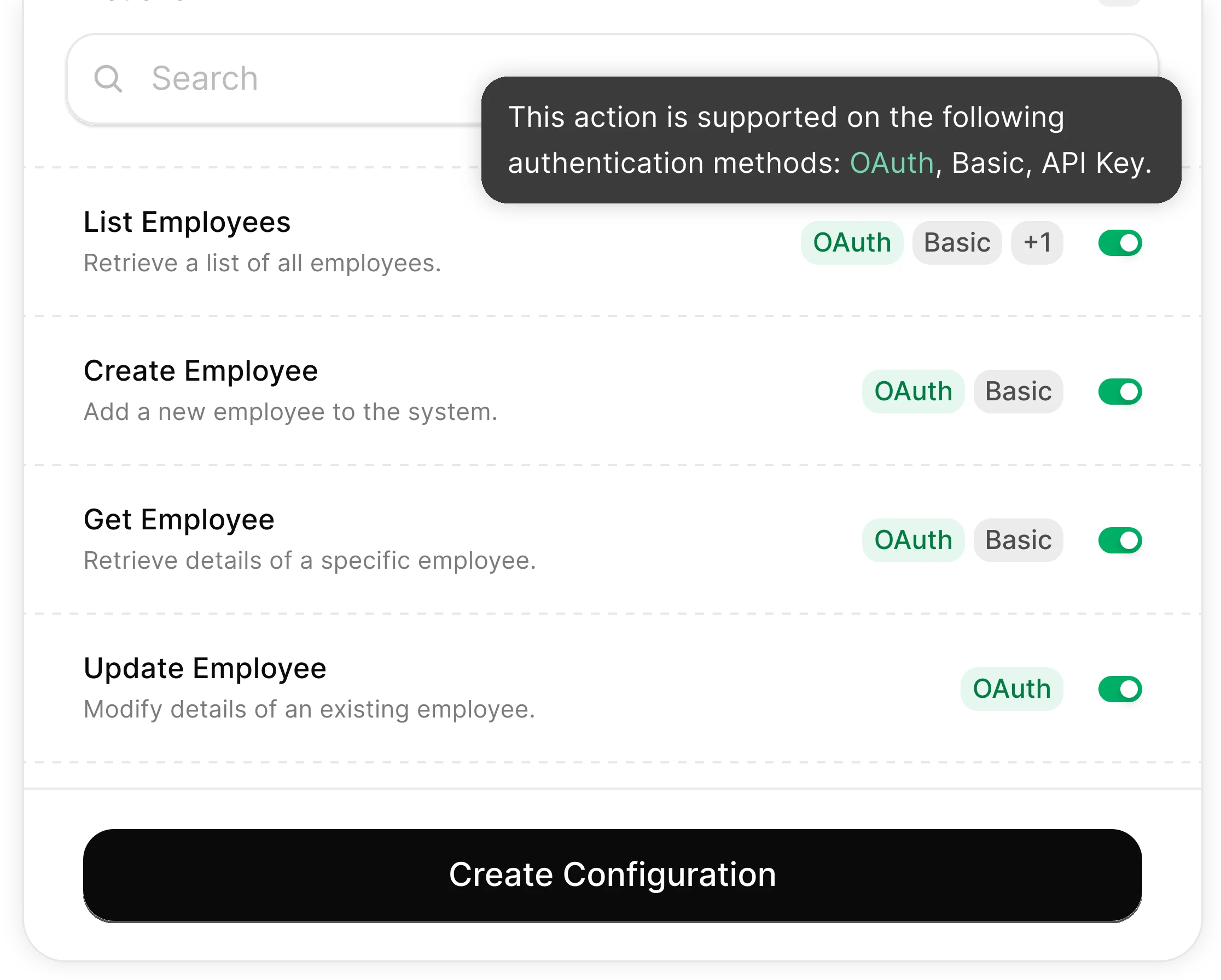
You Control What the Agent Can Do
Scoped permissions enforce read-only access to reporting endpoints per tenant. Full audit trail of every metric pull and report delivery.
Integrates with your entire marketing stack. Whatever it is.
Connect Any Agent to Automate Campaign Reports

Any Agent Framework
Claude, OpenAI, LangChain, Vercel AI SDK, CrewAI, Pydantic AI — StackOne works with every major agent framework out of the box.


Any Agent Builder
Whether you're building with code, a visual builder, or an enterprise platform — StackOne provides the integration layer your agent needs.
Connect Your Agent to Your Marketing Stack
Start building in minutes. MCP connectors to every system your agent needs.
Frequently Asked Questions
Connect Your Agent to Your Marketing Stack
Start building in minutes. MCP connectors to every system your agent needs.