Voice Call Summarization
Every Call. Logged. Instantly.
Use StackOne to connect your AI agent to your telephony, CRM, and messaging tools to automate voice call summarization and CRM logging.



AI Agents
Connect
MCP and A2A to REST, SOAP, and proprietary APIs.
Optimize
Tool discovery, data shaping, and reliable execution.
Secure
Scoped permissions, audit trails, and observability.
StackOne Integration Layer


 StackOne Integration Layer
Connect
200+ connectors, build your own, and multi-protocol support.
Optimize
Context, token, and speed optimization infrastructure.
Secure
Permissions API and prompt injection protection.
What Can AI Agents Do for Voice Call Summarization?
Your agent listens for completed calls, retrieves transcripts, generates structured summaries, and logs everything to the CRM — with follow-up tasks and notifications included.
Trigger on Call Completion
Receive a webhook when a recorded call ends from Gong, Fireflies.ai, or Twilio — with call ID, participants, duration, and recording URL.
Retrieve Transcript & Analyze
Pull the full call transcript with speaker diarization from Gong or Fireflies.ai. Extract key topics, sentiment, and action items from the conversation.
Generate Structured Summary
Produce a summary combining call metadata — date, duration, participants — with topics discussed, sentiment score, and agreed next steps. Pure in-agent reasoning, no external call required.
Log Summary to CRM
Look up the contact by email or phone in Salesforce or HubSpot, then write the structured summary as a new activity or note on the contact or deal record.
Create Follow-Up Tasks
If action items were identified in the summary, create follow-up tasks in the CRM assigned to the responsible rep or support agent — with due dates and context.
Notify the Agent
Send the support or sales agent a link to the call summary via Slack message or email — so they can review without digging through the CRM.
Trigger on Call Completion
Receive a webhook when a recorded call ends from Gong, Fireflies.ai, or Twilio — with call ID, participants, duration, and recording URL.
Retrieve Transcript & Analyze
Pull the full call transcript with speaker diarization from Gong or Fireflies.ai. Extract key topics, sentiment, and action items from the conversation.
Generate Structured Summary
Produce a summary combining call metadata — date, duration, participants — with topics discussed, sentiment score, and agreed next steps. Pure in-agent reasoning, no external call required.
Log Summary to CRM
Look up the contact by email or phone in Salesforce or HubSpot, then write the structured summary as a new activity or note on the contact or deal record.
Create Follow-Up Tasks
If action items were identified in the summary, create follow-up tasks in the CRM assigned to the responsible rep or support agent — with due dates and context.
Notify the Agent
Send the support or sales agent a link to the call summary via Slack message or email — so they can review without digging through the CRM.
Why Building a Good Call Summarization Agent Is Hard
Connecting Telephony and CRM Systems Across Providers
A call summarization agent needs connectors to Gong, Fireflies.ai, Twilio, Salesforce, HubSpot, and Slack. Each requires its own OAuth flow, pagination logic, and rate-limit handling — a massive engineering lift before the agent writes a single summary.
Call-Completed Webhooks Differ Across Every Provider
Gong, Fireflies.ai, and Twilio each deliver call-ended events with different payload formats, authentication schemes, and retry logic. Building separate webhook receivers and polling fallbacks per provider is ongoing infrastructure work.
CRM Activity Schemas Vary Per System
Logging structured call summaries to Salesforce, HubSpot, or Zendesk requires different activity objects, field mappings, and write patterns per CRM — multiplying connector maintenance every time you add a new customer.
Call Transcripts Carry Prompt Injection Risk
Transcripts are verbatim records of untrusted speech. Any participant can speak phrases that look natural in conversation but function as instructions when processed by an LLM — tricking the agent into corrupted CRM writes or data exfiltration.
How StackOne Makes Call Summarization Agents Possible
Everything your call summarization agent needs to retrieve transcripts, log to CRM, and notify teams — with the controls IT demands.
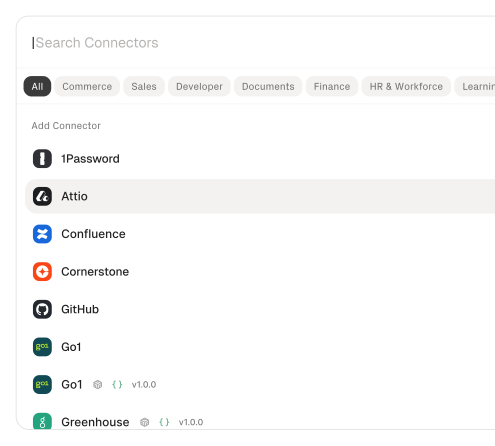
200+ connectors with 10K+ agent-optimized actions
Pre-built connectors for Gong, Fireflies.ai, Twilio, Salesforce, HubSpot, and Slack with full native action coverage and agent instructions included.
Managed Auth handles credentials across providers
OAuth flows, API keys, and token refresh managed per tenant for every connected telephony and CRM system — agents never touch raw credentials.
Search and execute finds the right action
Agent searches StackOne's action catalog by natural language and executes the matching telephony or CRM action — no pre-loading thousands of tool definitions.
Managed Webhooks deliver call events consistently
StackOne subscribes to call-completed events across connected telephony and meeting intelligence providers, handling registration, retries, and delivery differences so the agent receives a consistent event stream.
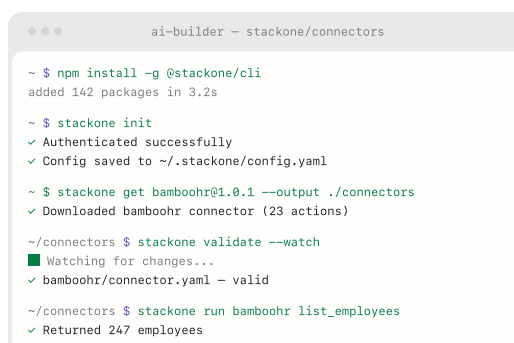
Connector Studio extends to any system
Build custom connectors for unsupported telephony platforms or internal CRMs via REST, SOAP, or GraphQL — no waiting on vendor support.
Defender blocks prompt injection from transcript content
StackOne Defender screens inbound transcript text for injection attempts before the agent processes it, preventing adversarial content from manipulating CRM writes.
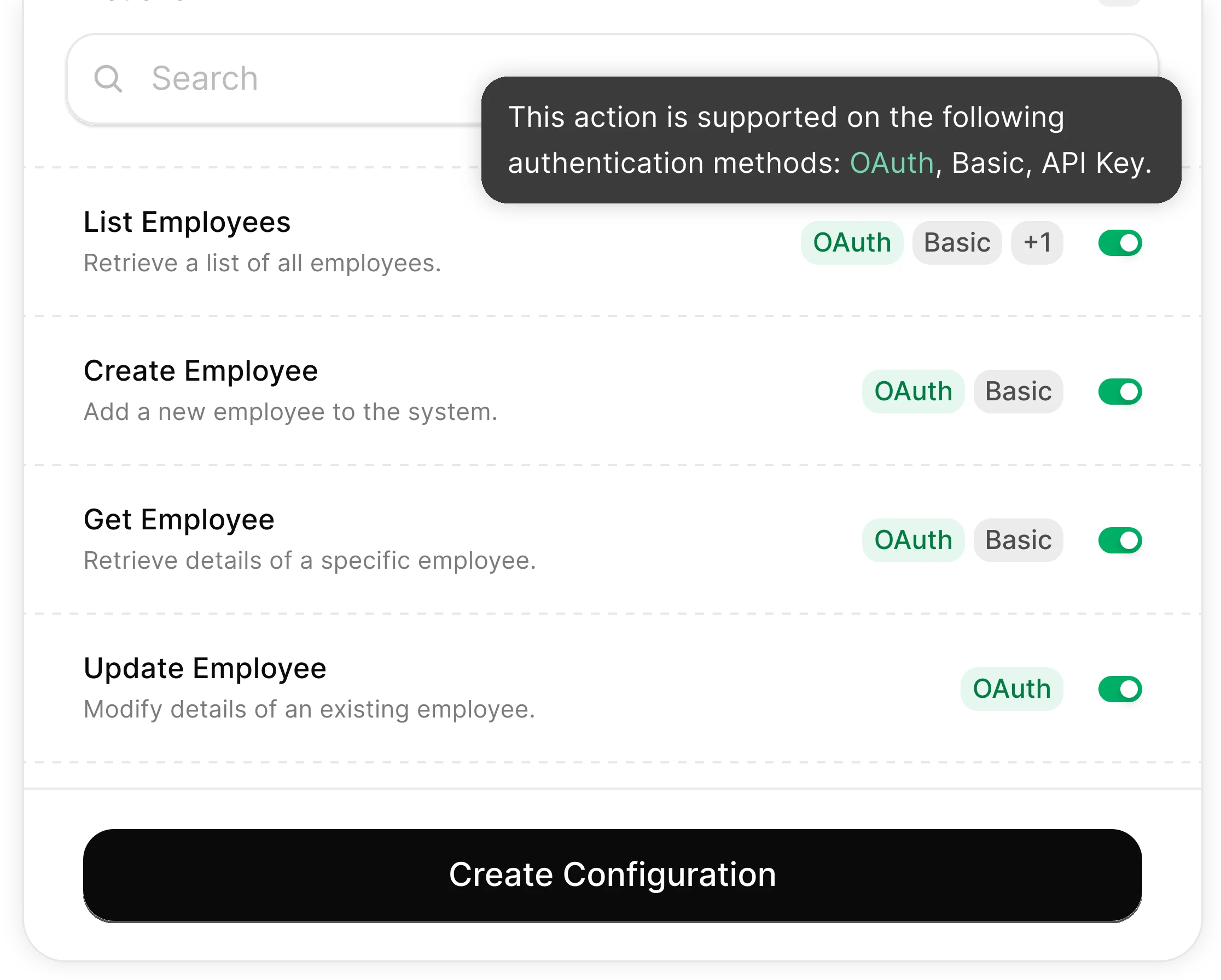
You Control What the Agent Can Do
Scoped permissions define exactly which transcript fields the agent reads and which CRM write actions it can trigger. Full audit trail of every operation.
Integrates with your entire telephony and CRM stack. Whatever it is.
Connect Any Agent to Automate Call Summarization

Any Agent Framework
Claude, OpenAI, LangChain, Vercel AI SDK, CrewAI, Pydantic AI — StackOne works with every major agent framework out of the box.


Any Agent Builder
Whether you're building with code, a visual builder, or an enterprise platform — StackOne provides the integration layer your agent needs.
Connect Your Agent to Your Telephony Stack
Start building in minutes. MCP connectors to every system your agent needs.
Frequently Asked Questions
Connect Your Agent to Your Telephony Stack
Start building in minutes. MCP connectors to every system your agent needs.