MCP vs A2A: Choosing the Right Protocol for AI Agents
Table of Contents
AI agents do two fundamentally different things. They reason about tasks and they act on external systems.
Reasoning happens inside the model. Acting requires structured access to APIs, databases, SaaS platforms, file systems, and enterprise software. As agents move from demos to production systems, this boundary becomes the architectural bottleneck.
Two emerging standards address different parts of this problem:
- MCP (Model Context Protocol): designed to standardize how AI agents access tools and external systems.
- A2A (Agent-to-Agent Protocol): designed to standardize how agents discover and delegate work to other agents.
They are often compared, sometimes confused, and occasionally treated as interchangeable. They are not.
This article explains the difference between MCP vs A2A, what each protocol standardizes, and how to decide which one your AI architecture actually needs.
What is MCP?
MCP (Model Context Protocol) is an open protocol introduced by Anthropic that standardizes how AI applications securely and consistently connect to external tools, workflows, and data sources.
At its core, MCP defines a structured interface between an AI client (such as an agent runtime or LLM application) and a server that exposes tools. Rather than hardcoding function schemas directly into prompts, MCP allows agents to discover available tools dynamically and invoke them through a consistent protocol.
Key insight: MCP separates reasoning from execution.
The model decides what action to take. The MCP server defines how that action is executed.
This separation enables interoperability across models, vendors, and tool providers. For a broader look at where MCP is headed, see MCP: where it’s been, where it’s going.
MCP Architecture: The Tool Integration Layer
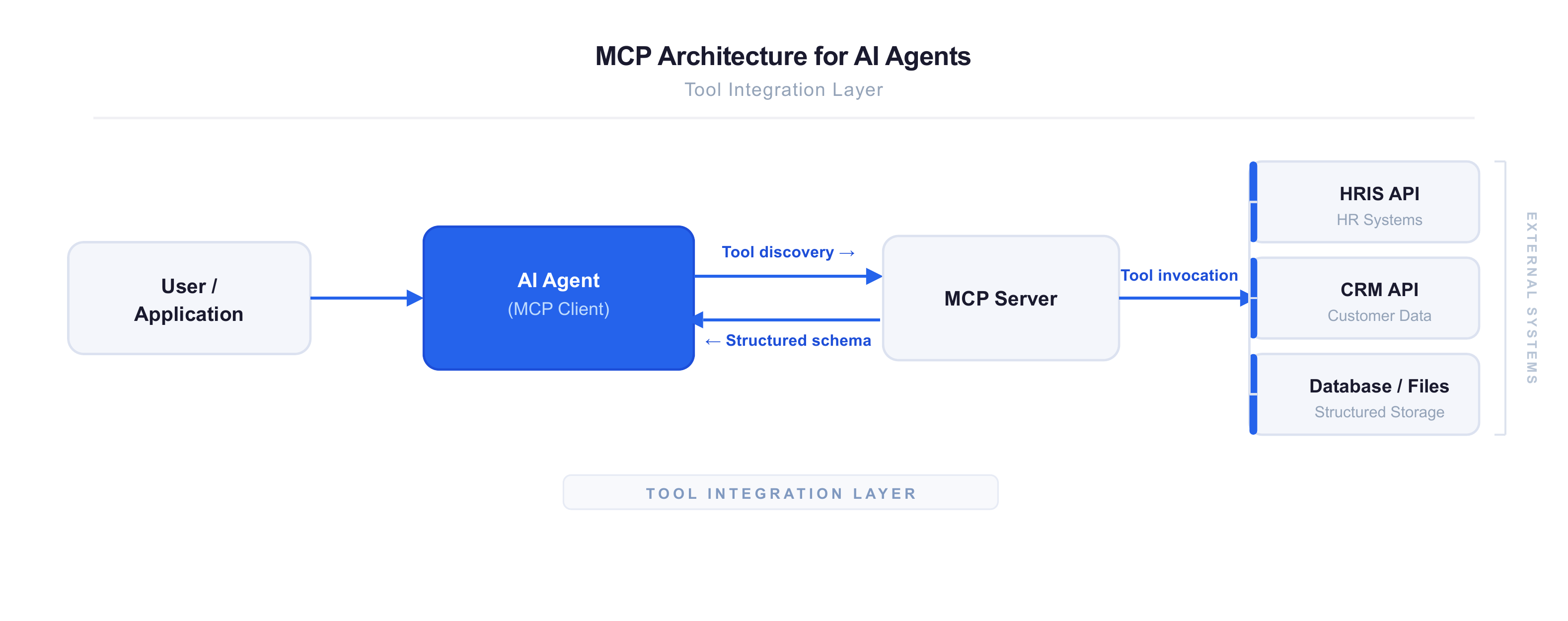
MCP follows a client–server architecture:
- MCP Client: The AI application or agent requesting tool usage.
- MCP Server: The service exposing structured tool definitions.
- Tools / Resources: APIs, databases, SaaS integrations, or workflows that can be invoked.
The protocol enables dynamic tool discovery, structured input/output schemas, transport over standardized channels (e.g., HTTP/SSE, stdio), and model-agnostic integration.
This makes MCP particularly useful when building agents that must interact with multiple external systems without tightly coupling tool definitions to a single framework.
Integration platforms such as StackOne MCP implement this model by exposing enterprise SaaS systems through a standardized MCP interface, enabling AI agents to connect to HR tools like BambooHR and Workday, CRMs like Salesforce and HubSpot, and operational tools without custom integration code.
What MCP Solves and What It Does Not
MCP solves a critical interoperability problem: how an AI agent calls external tools in a standardized, reusable way.
However, MCP does not standardize:
- Human approval workflows
- Multi-tenant isolation policies
- Execution middleware or security hooks
- Agent-to-agent delegation
Boundary: MCP is a protocol for tool discovery and invocation, not a full agent orchestration framework. It operates at the tool integration layer.
What is A2A?
A2A (Agent-to-Agent Protocol) is a protocol introduced by Google to standardize how AI agents discover, communicate with, and delegate work to other agents.
While MCP focuses on how an agent connects to tools, A2A focuses on how one agent collaborates with another. It defines a structured way for agents to advertise capabilities, accept tasks, exchange artifacts, and manage task lifecycles.
In practical terms: One agent identifies a task it cannot complete alone, then delegates that task to another agent through a standardized protocol.
A2A operates at the coordination layer of the agent stack.
A2A Architecture: The Agent Coordination Layer
A2A introduces several core concepts:
- Agent Card: A structured declaration of an agent’s capabilities.
- Task: A unit of delegated work between agents.
- Artifacts: Structured outputs or intermediate results.
- Task Lifecycle: Creation, execution, updates, and completion states.
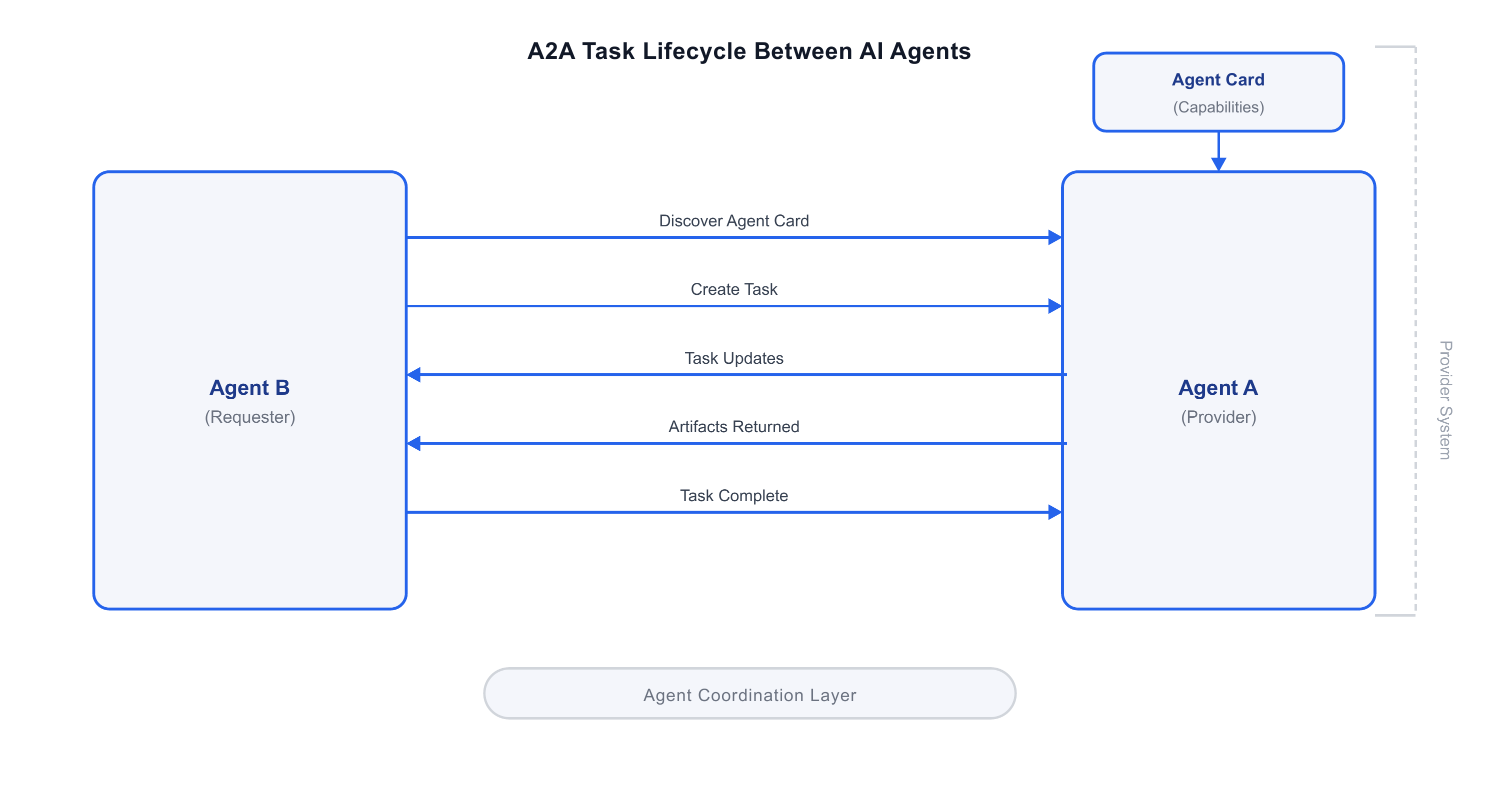
In a typical A2A flow:
- Agent A publishes its capabilities via an Agent Card.
- Agent B discovers those capabilities.
- Agent B creates a structured task request.
- Agent A executes the task and returns artifacts.
Unlike MCP, which connects agents to systems, A2A connects agents to agents.
Example: A2A Agent Card Structure
Below is a simplified example of how an Agent Card might be represented:
{
  "name": "candidate-screening-agent",
  "description": "Screens resumes and ranks
    candidates",
  "capabilities": [
    {
      "action": "rank_candidates",
      "input_schema": {
        "type": "object",
        "properties": {
          "job_description": {
            "type": "string"
          },
          "candidate_profiles": {
            "type": "array"
          }
        }
      }
    }
  ]
}
This structured declaration allows other agents to discover what this agent can do and how to invoke it.
What A2A Solves and What It Does Not
A2A standardizes agent capability discovery, structured task delegation, multi-agent collaboration, and long-running asynchronous workflows.
However, A2A does not standardize direct external tool execution, API integration patterns, or system-level data access.
The distinction:
MCP enables agents to act on systems. A2A enables agents to coordinate with other agents.
MCP vs A2A: What’s the Difference?
Understanding MCP vs A2A requires recognizing that they operate at different layers of the AI agent stack.
MCP standardizes how an agent interacts with external systems. A2A standardizes how agents interact with other agents. They solve adjacent but fundamentally different problems.
| Dimension | MCP (Model Context Protocol) | A2A (Agent-to-Agent Protocol) |
|---|---|---|
| Primary Purpose | Standardizes tool and system integration for AI agents | Standardizes inter-agent communication and delegation |
| Architecture Layer | Tool Integration Layer | Agent Coordination Layer |
| Communication | Client–Server (Agent ↔ MCP Server) | Peer-to-Peer (Agent ↔ Agent) |
| Core Objects | Tools, Resources, Structured Schemas | Agent Cards, Tasks, Artifacts |
| Trust Boundary | Between agent and external systems | Between autonomous agents |
| Latency Model | Short-lived, synchronous tool calls | Often long-running, asynchronous tasks |
| Example Use Case | Agent calling HRIS API to create an employee record | Agent delegating resume screening to a specialist agent |
Architectural Differences Between MCP and A2A
The architectural distinction becomes clearer when examining system boundaries.
With MCP, the AI agent remains the central decision-maker. It uses external tools to execute actions but retains control over orchestration. The MCP server exposes capabilities; the agent chooses when and how to invoke them.
With A2A, orchestration is distributed. An agent may delegate work to other agents that operate semi-independently, each with its own capabilities and task lifecycle.
This difference impacts system design in several ways:
- Scope of Autonomy: MCP keeps autonomy centralized; A2A distributes autonomy.
- Failure Handling: MCP failures resemble API errors; A2A failures resemble workflow breakdowns.
- Scaling Model: MCP scales with infrastructure integrations; A2A scales with agent specialization.
MCP answers: “How does this agent act on the world?”
A2A answers: “How do multiple agents collaborate to solve complex tasks?”
This layered distinction is critical when deciding whether your architecture requires tool integration, agent delegation, or both.
MCP vs A2A Decision Framework
Choosing between MCP vs A2A is not a matter of preference. It depends on the architectural problem you are solving.
MCP vs A2A Decision Tree
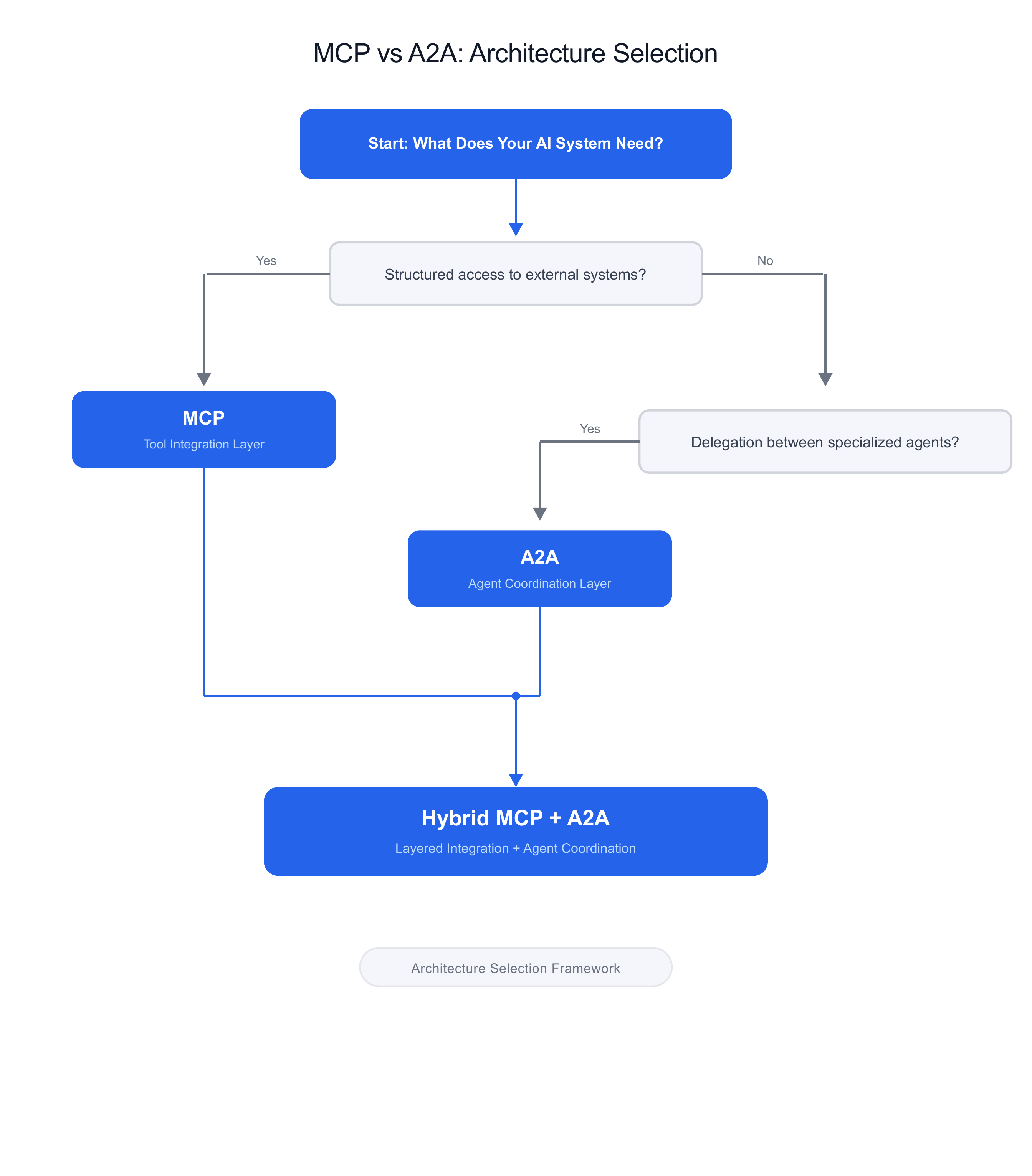
At a high level:
- If your primary need is structured access to external systems (APIs, databases, SaaS platforms), you likely need MCP.
- If your primary need is delegation between specialized agents, you likely need A2A.
- If your system requires both tool execution and agent collaboration, a hybrid MCP + A2A architecture is appropriate.
MCP vs A2A Weighted Decision Matrix
For more complex systems, especially in enterprise or multi-tenant environments, a scoring matrix provides greater clarity.
| Criterion | Wt | MCP | A2A | Notes |
|---|---|---|---|---|
| External API Integration | 5 | 5 | 1 | MCP excels at structured tool access |
| Agent Specialization | 4 | 2 | 5 | A2A enables multi-agent workflows |
| Long-Running Async | 3 | 2 | 5 | A2A supports task lifecycle mgmt |
| Centralized Orchestration | 3 | 5 | 2 | MCP keeps control in single agent |
| Cross-Org Collaboration | 4 | 2 | 5 | A2A supports capability discovery |
| Infrastructure Simplicity | 2 | 4 | 3 | MCP simpler for single-agent systems |
To use this matrix: assign weights based on the importance of each criterion in your system, multiply weight by score, and compare total weighted scores. The protocol with the higher weighted score better aligns with your architectural needs.
When to Use Hybrid MCP + A2A Architecture
Many production systems do not fit neatly into one category.
Example: A recruiting agent may use MCP to interact with HR systems, and A2A to delegate resume analysis to a specialized screening agent.
MCP provides deterministic system integration. A2A provides modular agent collaboration.
Understanding this layering — tool integration vs agent coordination. This prevents overengineering and clarifies where each protocol belongs in your stack.
MCP vs A2A Architecture Patterns in Practice
Understanding which protocol to adopt is only part of the decision. The next question is architectural: how does MCP vs A2A actually shape the structure of your AI system?
Below are the three dominant implementation models seen in production systems.
Pattern 1: MCP-Dominant Architecture
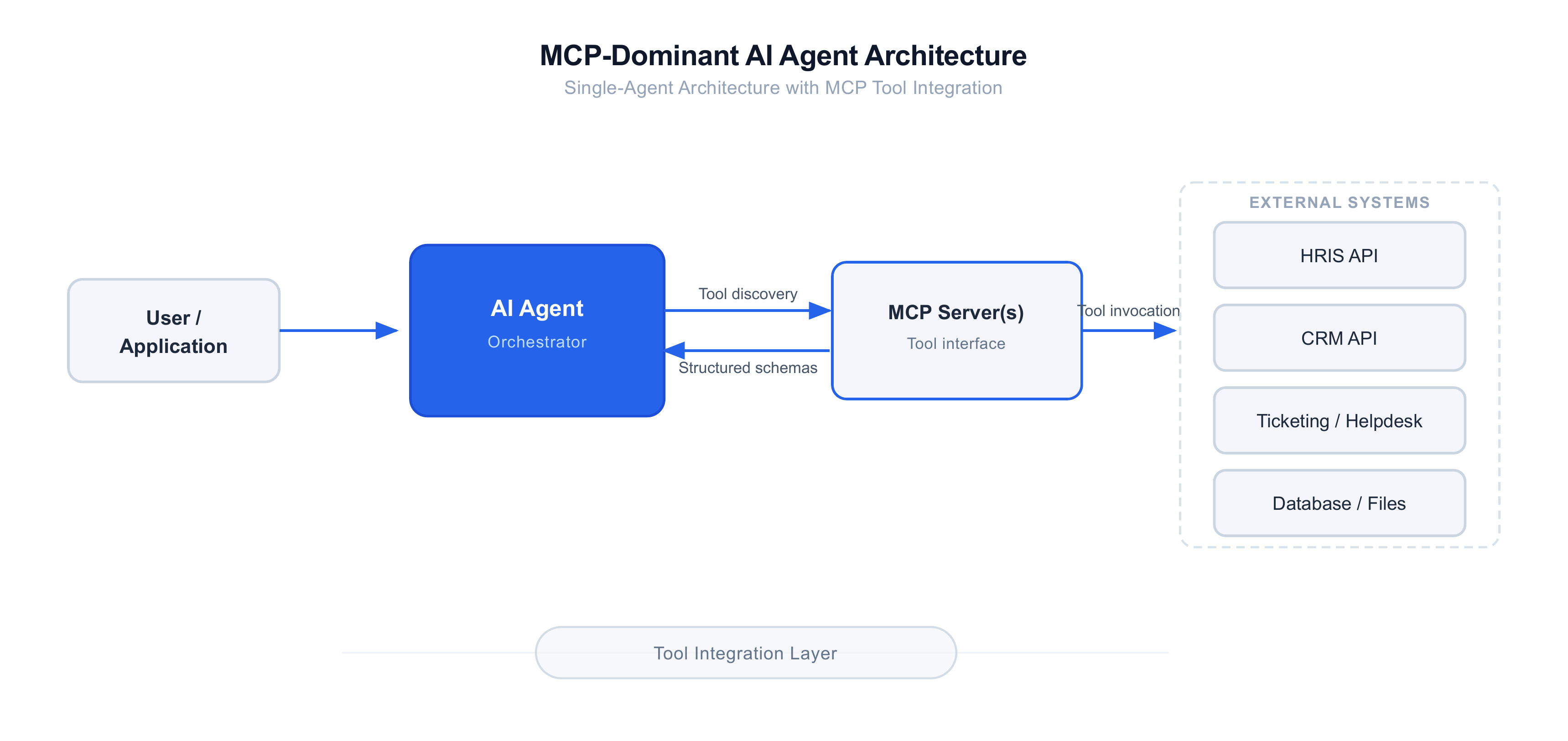
In an MCP-dominant architecture, a single agent acts as the central orchestrator. It connects to external systems through MCP servers and invokes tools as needed.
Characteristics: centralized reasoning, deterministic system integration, clear infrastructure boundaries, and strong fit for workflow automation.
This model works well when the complexity lies in system integrations rather than agent specialization. Enterprise automation, internal copilots, and API-driven workflows often fit this pattern. For a deeper look at MCP tooling choices in this architecture, see MCP vs SDK: choosing your agent toolkit.
Pattern 2: A2A-Based Multi-Agent Architecture
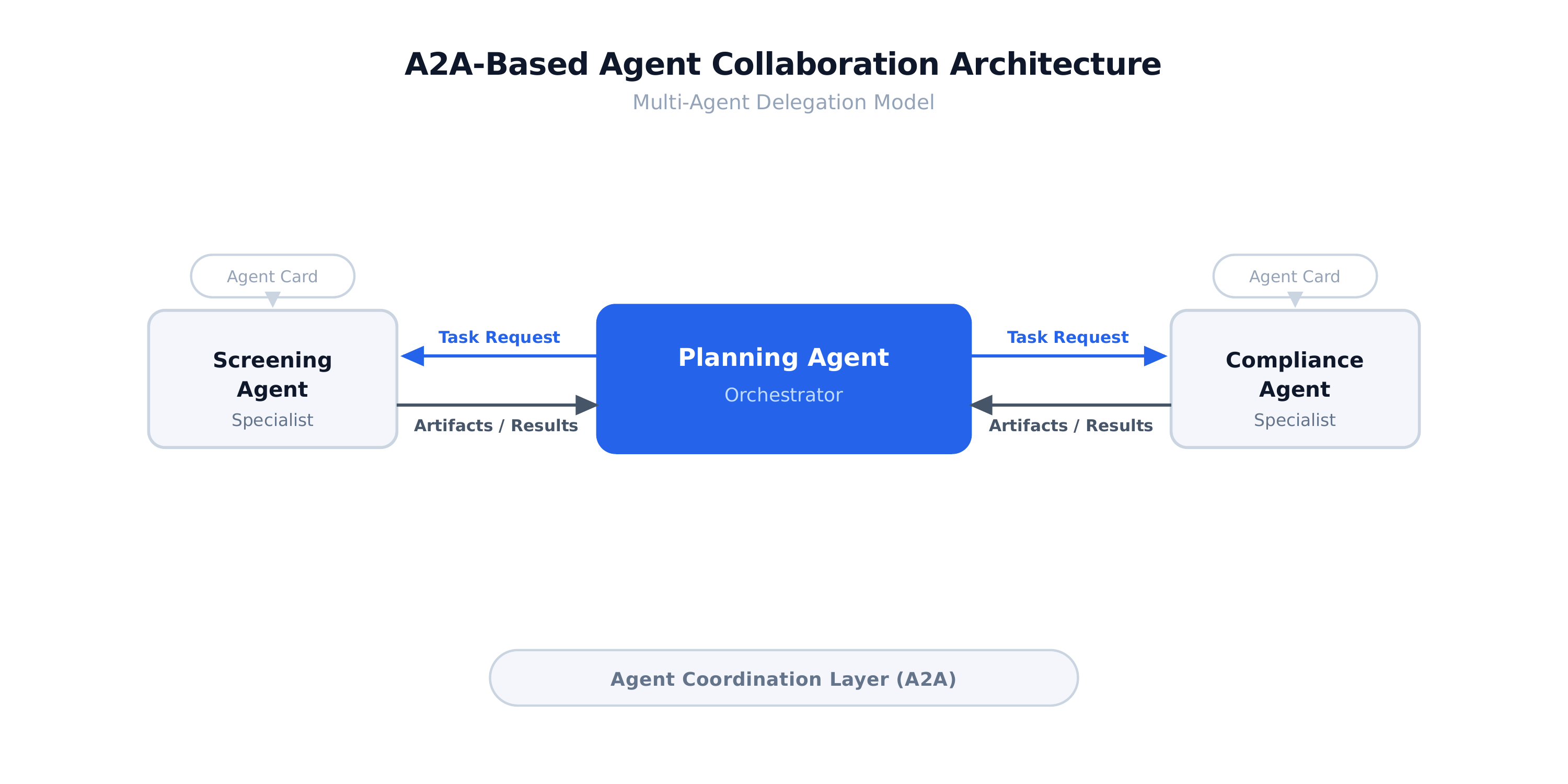
In an A2A-based architecture, multiple specialized agents collaborate through structured delegation. Instead of a single orchestrator calling tools directly, agents advertise capabilities and accept tasks from other agents.
Characteristics: distributed reasoning, capability-based delegation, long-running task lifecycles, and clear specialization boundaries.
This model is suited for systems where expertise is modular — for example, one agent handles planning, another handles analysis, and another handles compliance checks.
Pattern 3: Hybrid MCP + A2A Architecture
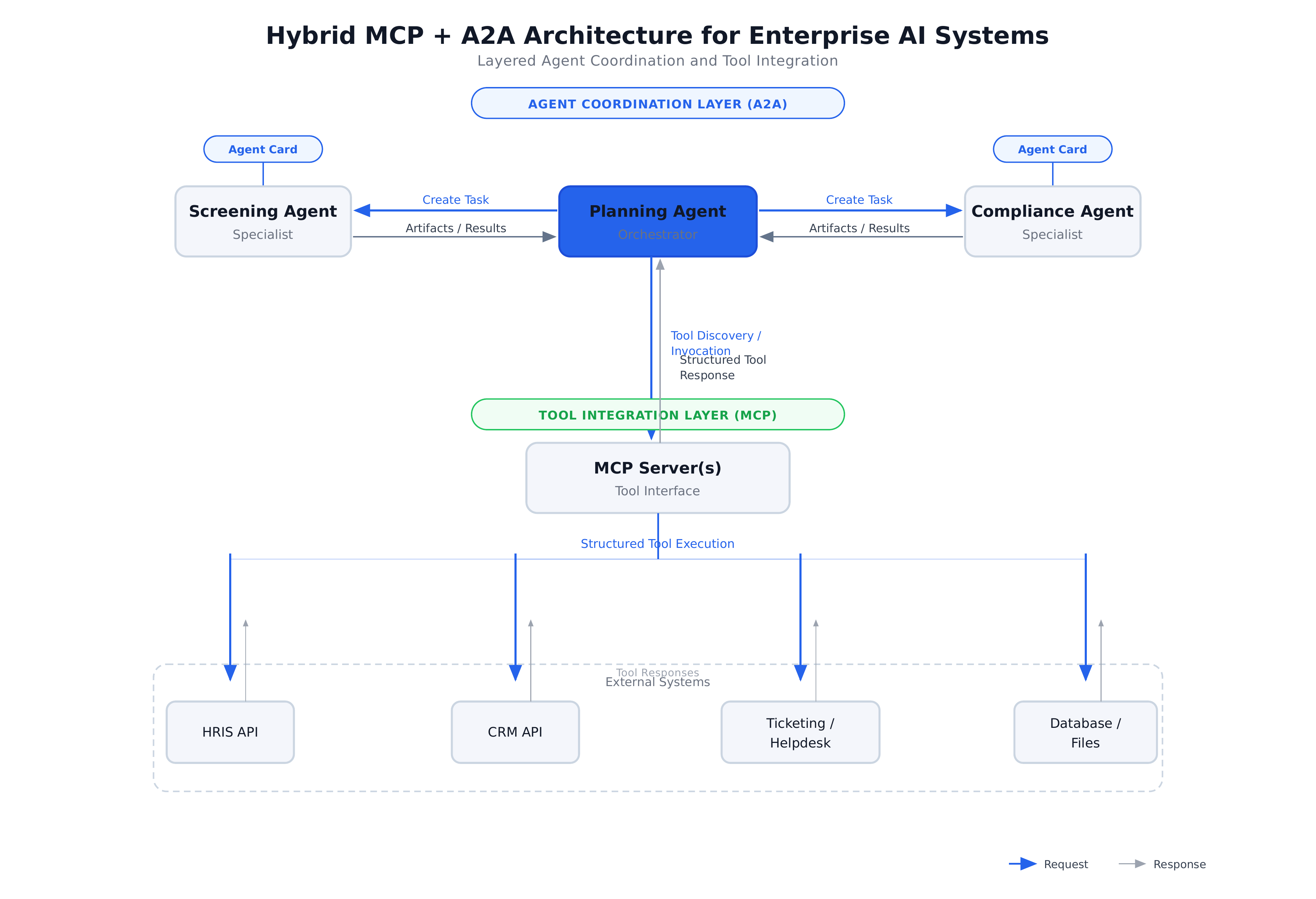
In practice, many production systems combine both protocols. MCP handles structured access to external systems, while A2A handles delegation between specialized agents.
Example:
A planning agent uses A2A to delegate resume screening to a specialist agent. The screening agent uses MCP to retrieve candidate data from an HR system.
This layered approach separates concerns cleanly: tool integration remains deterministic and auditable, while agent collaboration remains modular and extensible.
Hybrid architectures are especially common in enterprise environments, where systems must integrate with multiple SaaS platforms while also supporting modular agent specialization.
In practice, platforms such as StackOne MCP and StackOne A2A support this layered architecture by combining structured system integration with agent coordination patterns required for enterprise-grade deployments.
When implemented carefully, MCP and A2A do not compete. They operate at complementary layers of the same agent stack.
MCP vs A2A: Indirect Prompt Injection Across Both Protocols
Neither protocol was designed with adversarial input as a first-class concern. Security researchers have demonstrated critical flaws in both MCP and A2A, and OWASP ranks indirect prompt injection as the #1 risk for LLM applications in 2025. The attack surface differs between protocols. The underlying vulnerability does not.
How Indirect Prompt Injection Differs in MCP vs A2A
In MCP, the attack is static. A poisoned tool response contains hidden instructions that can’t change after delivery. The payload persists in the agent’s context window across subsequent tool calls, but the attacker gets no feedback and no chance to adjust. An attacker hides a display:none div in an email, the Gmail MCP tool returns the full HTML, and the agent forwards sensitive data before the user sees anything. See 10 real indirect prompt injection examples for how this plays out across Salesforce, Slack, Jira, and seven other integrations.
In A2A, the attack is stateful. Palo Alto Unit 42’s “Agent Session Smuggling” research showed that A2A’s multi-turn sessions let attackers do something MCP doesn’t allow: adapt. An attacker embeds a covert instruction in a delegated task, observes how the receiving agent responds, and refines the injection in the next message. The “Prompt Infection” paper describes this as self-replicating injection, where a compromised agent propagates malicious instructions to agents it delegates to. The “Improving A2A Protocol” research confirmed the current spec has no built-in defense.
That difference matters for the hybrid architectures described above. In theory, a compromised A2A agent that delegates tasks via MCP could spread an injection from the coordination layer down into the tool layer, turning one poisoned agent message into dozens of poisoned tool calls.
| Dimension | MCP | A2A |
|---|---|---|
| Attack surface | Tool responses (APIs, files, emails) | Agent messages and task artifacts |
| Injection vector | Hidden instructions in retrieved data | Covert instructions in delegated tasks |
| Persistence | Static payload, persists in context but can’t adapt | Adaptive, refines across multi-turn sessions |
| Propagation | Contained to agent’s current session | Can spread across agent delegation chains |
MCP and A2A Security: Defending Against Indirect Prompt Injection
The defense is protocol-agnostic: scan data before it enters the context window. Google’s security team recommends layered defense combining input scanning, output filtering, and least-privilege permissions. The scan point differs by protocol. In MCP, you intercept tool responses. In A2A, you intercept incoming agent messages and task artifacts. The scanning approach is comparable, though the interception points and message structures differ.
StackOne Defender implements this as an open-source scanner that works at both layers. Two-tier detection (pattern matching + ML classifier) in ~10ms on CPU, no GPU required. For the technical details on how the detection pipeline works, see the indirect prompt injection defense guide.
Key insight: MCP and A2A face the same indirect prompt injection vulnerability. Untrusted data entering the agent’s context window. The protocol changes the transport, not the threat.
MCP vs A2A Production Readiness
Architectural clarity is only the first step. Production systems introduce constraints that neither MCP nor A2A fully abstract away.
MCP vs A2A Observability and Task Tracing
In MCP-based systems, observability typically focuses on tool invocation logs, input/output auditing, and API latency and failure rates.
In A2A-based systems, observability extends to task lifecycle tracking, inter-agent message tracing, and artifact versioning. As delegation chains grow, tracing becomes essential to prevent opaque multi-agent failure modes.
Multi-Tenant Isolation for MCP and A2A
Enterprise and SaaS environments introduce additional constraints: account-scoped tool visibility, per-tenant rate limits, audit logs per customer, and isolation between agent contexts.
MCP standardizes tool access, but it does not define tenant-level isolation policies. A2A standardizes delegation, but it does not define cross-tenant governance. These capabilities must be implemented at the system architecture layer.
Enterprise-focused implementations such as StackOne MCP and StackOne A2A extend protocol standards with tenant-scoped visibility, governance controls, and auditability required for multi-tenant SaaS environments.
MCP vs A2A Failure Modes and Resilience
Failure behavior differs across protocols:
MCP failures resemble API errors: timeouts, schema mismatches, permission issues. A2A failures resemble workflow failures: stalled tasks, incomplete artifact chains, orphaned delegations.
Designing for retries, idempotency, and recovery requires understanding which layer the failure originates from.
| Concern | MCP Considerations | A2A Considerations |
|---|---|---|
| Authentication | API-level auth, OAuth, token handling | Agent identity verification |
| Authorization | Tool-level permissions | Task-level delegation policies |
| Observability | Tool call logging | Task lifecycle tracing |
| Failure Handling | API retries, fallback logic | Workflow recovery, stalled task detection |
| Multi-Tenancy | Tenant-scoped tool access | Tenant-scoped agent visibility |
| Token Efficiency | Tool schema size, context overhead | Artifact size and message history growth |
In practice, production-ready systems often require additional infrastructure beyond the protocol specification itself. MCP and A2A define interoperability standards. They do not replace governance, monitoring, or execution control layers.
MCP vs A2A Use Cases and Real-World Examples
Understanding MCP vs A2A becomes clearer when mapped to real-world scenarios. Most production systems fall into one of three categories.
MCP for Enterprise Automation
In enterprise automation, an AI agent interacts directly with external systems such as HR platforms, CRM tools, ticketing systems, or internal databases.
Typical example: an HR assistant agent creates employee records in an HRIS, or a support agent updates tickets in a helpdesk platform.
These workflows primarily require structured tool execution. MCP is well suited because the architectural complexity lies in system integration rather than agent specialization.
A2A for Multi-Agent Analytical Workflows
In more complex systems, tasks are distributed across specialized agents. For example: a planning agent defines a hiring strategy, a screening agent evaluates resumes, and a compliance agent validates regulatory requirements.
In this scenario, delegation and capability discovery are central. A2A enables agents to collaborate through structured task lifecycles.
Hybrid MCP + A2A Enterprise Systems
Many real-world systems combine both patterns. A customer support orchestration agent delegates sentiment analysis to a specialist agent (A2A), while the specialist retrieves ticket history from a CRM via structured tool access (MCP).
| Use Case | Role of MCP | Role of A2A |
|---|---|---|
| HR Automation | Create/update employee records via API | Not required unless delegating to specialists |
| Customer Support | Retrieve and update tickets in CRM | Delegate sentiment analysis or escalation |
| Recruiting | Access applicant tracking systems | Delegate resume ranking to screening agent |
| Financial Reporting | Pull structured data from ERP systems | Delegate forecasting to analytics agent |
| Developer Tools | Query GitHub and CI systems | Delegate code review to specialist agent |
In practice, most enterprise-grade AI systems eventually converge toward a hybrid model. Tool integration and agent collaboration address different dimensions of complexity.
MCP vs A2A: Practical Recommendations
The MCP vs A2A decision is not about choosing a superior protocol. It is about identifying the layer of complexity in your system.
Choose MCP if:
- Your primary requirement is structured integration with external systems.
- You need deterministic, auditable tool execution.
- Your architecture centers around a single orchestrating agent.
Choose A2A if:
- Your system relies on multiple specialized agents.
- Delegation and capability discovery are core requirements.
- Workflows are long-running or distributed across independent components.
Adopt a hybrid MCP + A2A architecture if:
- Your agents must both integrate with enterprise systems and collaborate with other agents.
- You require modular specialization without sacrificing structured system access.
- Your environment introduces governance, multi-tenant, or observability constraints.
In modern AI systems, MCP and A2A operate at complementary layers:
MCP connects agents to the external world. A2A connects agents to each other.
Treating them as competing alternatives oversimplifies the architectural landscape. When applied deliberately, they form a layered foundation for building scalable, production-ready AI agent systems.
StackOne provides both MCP and A2A support for enterprise AI systems, combining structured tool integration with agent coordination patterns out of the box. Start free with StackOne MCP →