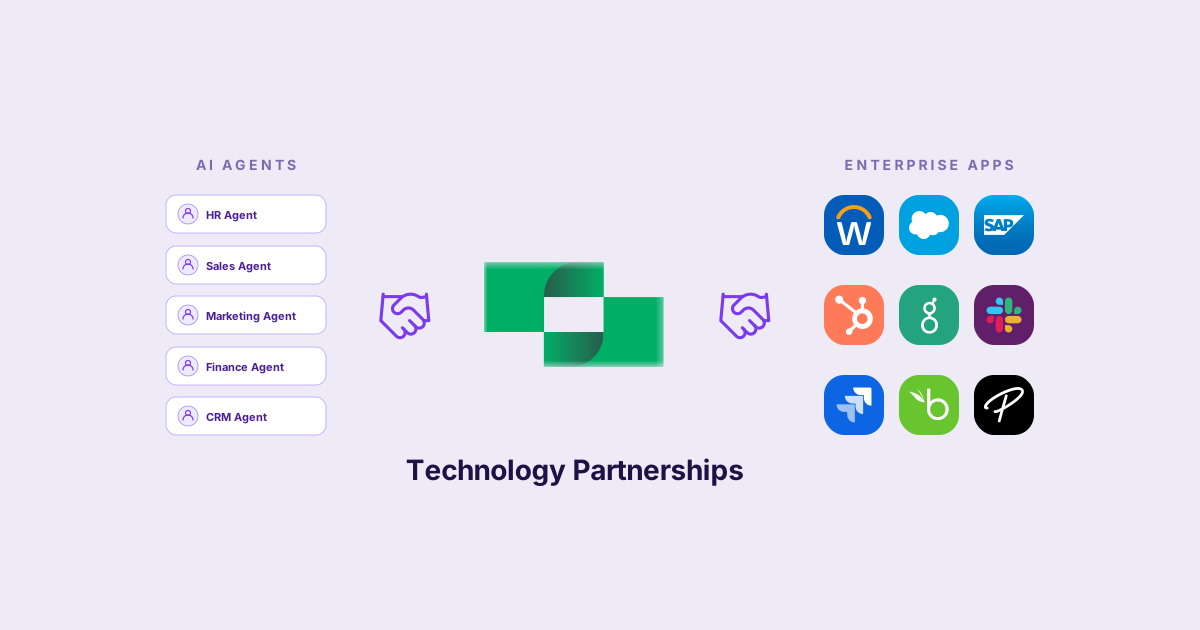
From Handshake to Integration: Your Complete Guide to Technology Partnerships
Table of Contents
I’ve spent my career building partnerships in the SaaS world — from launching global marketplaces to negotiating deals with industry giants like Salesforce and SAP SuccessFactors.
Along the way, I’ve learnt one fundamental truth that’s often overlooked: whilst strategic alignment, contracts, and go-to-market planning rightly get significant attention, the technical foundation — how well your products actually connect and interoperate — deserves equal weight in that conversation.
The two are inseparable. You can have the perfect partnership agreement and enthusiastic sales teams on both sides, but if the connectivity between your products is clunky, customers will notice. Both sides of the equation matter — it’s just that one tends to get the spotlight earlier in the process.
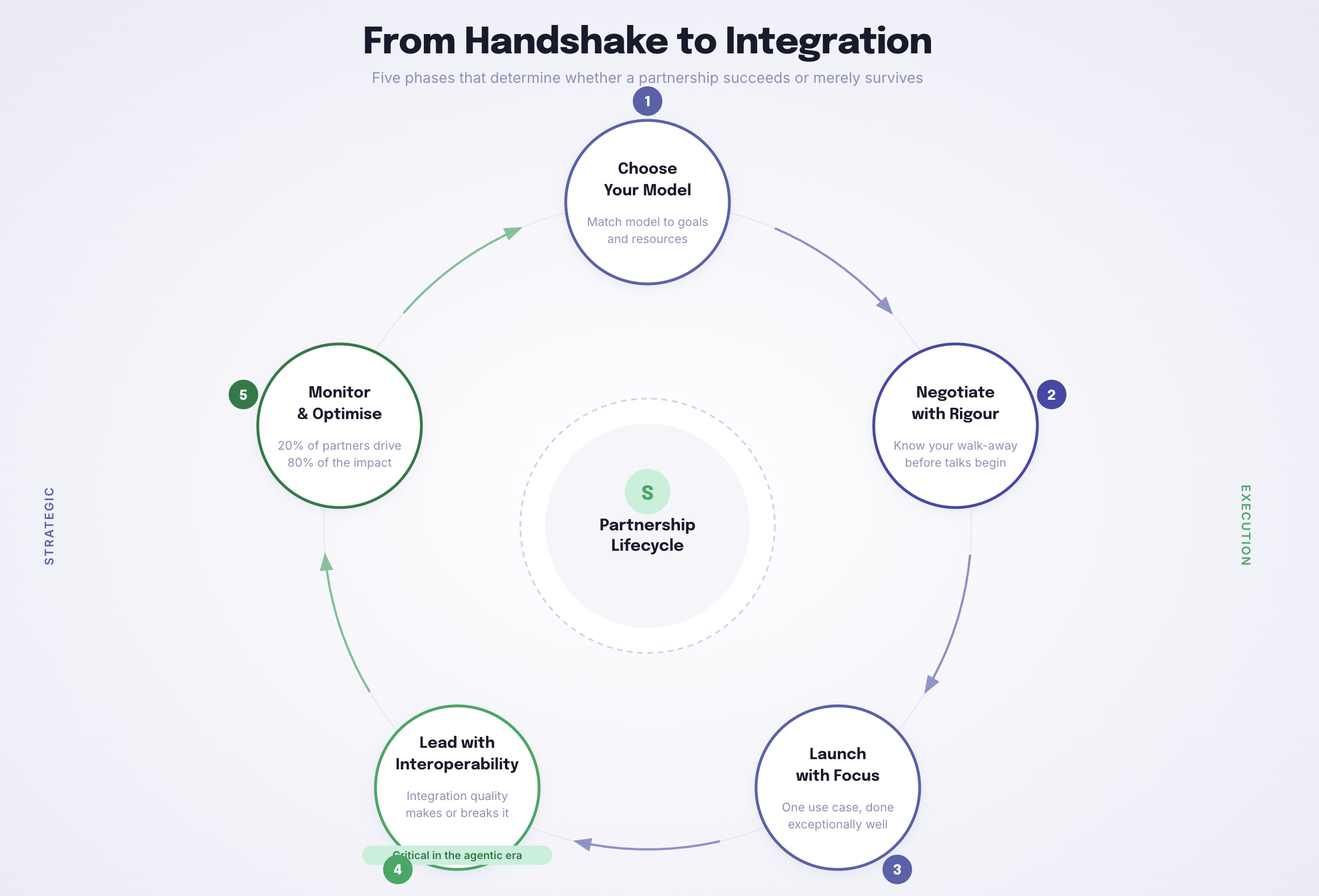
This guide walks you through the entire partnership lifecycle: choosing the right model, negotiating the deal, launching with impact, and ensuring your integration creates the seamless experience that keeps customers happy. Because in today’s interconnected ecosystem, interoperability isn’t everything — but it’s the piece that’s most commonly underestimated. And with AI agents now acting autonomously across these very systems, the cost of getting it wrong is higher than ever.
Technology Partnership Key Takeaways
Choose your partnership model carefully: Match your tech partnership model (referral, reseller, product, or integration) to your strategic goals and resources.
Negotiate with rigour: Track changes religiously, lead with questions before redlines, and know your walk-away point before you start.
Launch with focus: One compelling joint use case, well executed, beats ten half-baked ones. Create sales champions on both sides and make it dead simple for teams to help each other.
Lead with interoperability: Integration quality makes or breaks partnerships — plan your integration approach early, not as an afterthought.
Monitor and invest ruthlessly. 20% of partners drive 80% of impact. Identify them and invest accordingly.
Think in partner categories. AI agents are creating new types of partnerships — agentic workflow platforms, system integrators building agent-powered solutions, systems of record that depend on interoperability to stay relevant. Know where you fit.
What Is a Technology Partnership?
A tech partnership is a strategic collaboration between two companies whose products or services work together to create value for customers. This goes beyond simple co-marketing arrangements where companies share the same ideal customer profile (ICP) but don’t integrate their platforms.
True tech partnerships are built on technical interoperability — whether that’s through API integrations, agentic integration, or embedded product experiences. The products communicate, share data, and enable workflows that neither could deliver alone. It’s the difference between two companies that talk about each other versus two platforms that talk to each other.
Choosing Your Technology Partnership Model
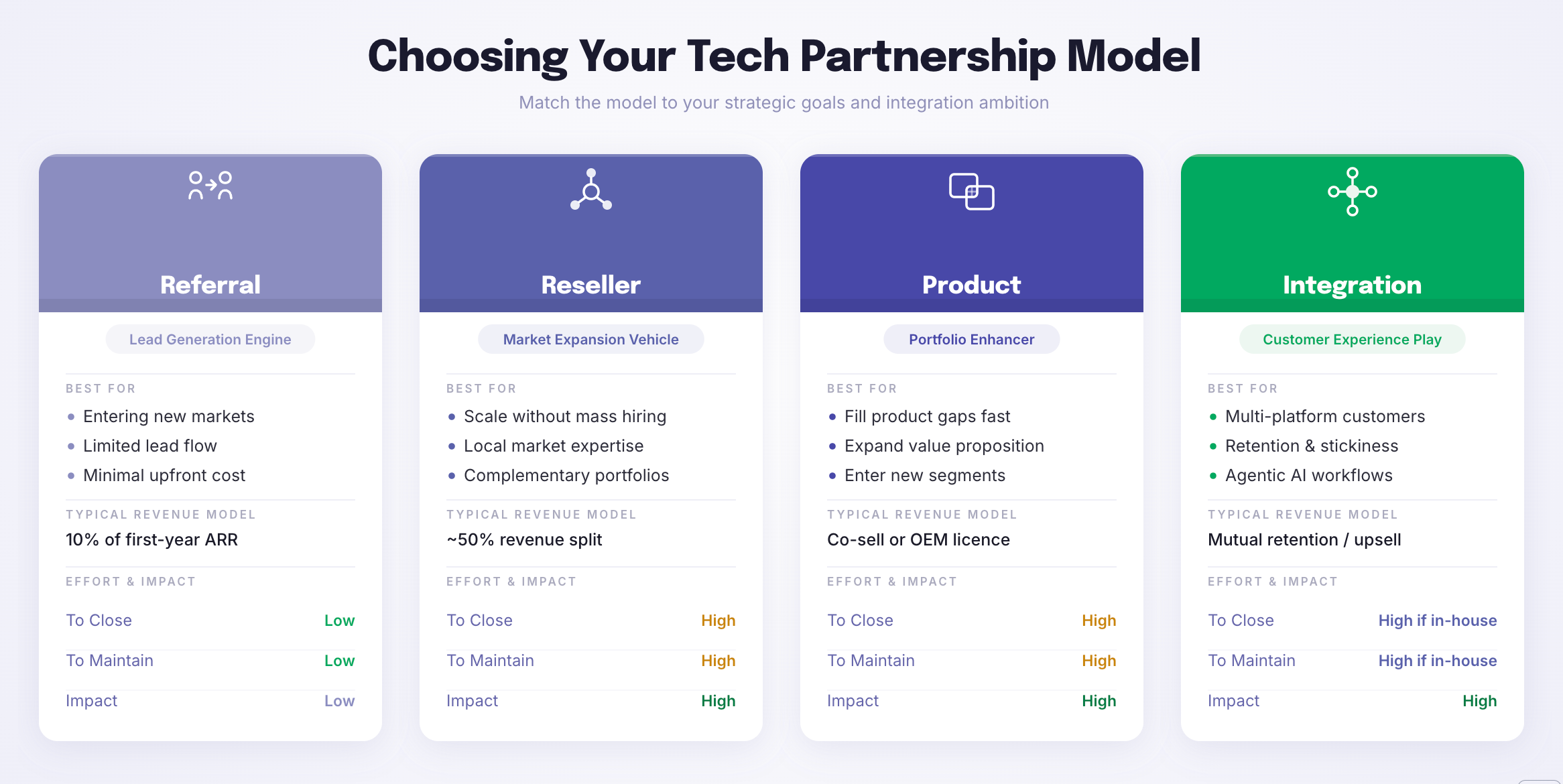
Before you shake hands, you need to understand what kind of tech partnership you’re building. In my experience, getting this wrong is like ordering a sports car when you needed a lorry — maybe impressive, but useless for your actual needs.
Referral Partnerships: The Lead Generation Engine
Think of referral partnerships as your business matchmakers. These partners identify potential customers who’d be perfect for your SaaS solution and make the introduction.
How it works: The referral partner acts as an intermediary, connecting your business with potential clients. Upon a successful sale, they receive a one-time fee — typically 10% of the first year’s revenue.
Perfect for:
- SaaS companies entering new markets without local presence
- Businesses with strong sales teams but limited lead generation
- Organisations looking for qualified leads with minimal upfront investment
The catch? You’ll need robust sales capabilities to convert those leads. A referral partnership without a strong closer is like having a brilliant wingman when you can’t hold a conversation — ultimately disappointing for everyone involved.
Reseller / Distribution Partnerships: Your Market Expansion Vehicle
These channel partnerships multiply your sales force without the overhead of hiring. Your partners become extensions of your sales team, selling your solutions as part of their portfolio.
How it works: Reseller partners proactively identify potential customers and manage the entire sales process, including billing the end customer. Revenue is typically shared 50/50, though this is always negotiable depending on who does what in the arrangement.
When to consider it:
- You’re ready to scale your SaaS platform but don’t want to build a massive sales team
- You need local market expertise in new territories
- Your product complements your partners’ existing tech offerings
Real-world example: Gusto reached $500M in trailing revenue and partnered with Remote to support international hires, expanding their market reach through a strategic channel partnership that combined their payroll platform with Remote’s global employment capabilities.
Success factor: Training matters. Begin with comprehensive initial training, follow with regular product updates via webinars and workshops, and establish a repeatable certification process. A poorly trained reseller is worse than no reseller at all, as they might misrepresent your offering.
Product Partnerships: The Portfolio Enhancer
Product partnerships bring complementary tech solutions together to create a more complete offering. Rather than spending months building a capability from scratch, you embed or bundle a partner’s product alongside your own. I’ve seen this referred to as “fast product development” — it widens your product scope with minimal engineering investment, reducing time to market.
How it works: One partner’s product fills a gap in the other’s platform, often through a deeply integrated or white-labelled experience. The commercial model varies — revenue share, bundled pricing, or a licensing arrangement — depending on how embedded the partner’s product becomes.
Example: An Applicant Tracking System partnering with a best-in-class AI video interviewing solution, giving customers a seamless hiring workflow without either company building outside their core competency. Or a CRM platform embedding a contract management tool so sales teams can send agreements without leaving the platform.
Best suited for:
- Companies looking to fill product gaps without diverting engineering resources
- Platforms competing against all-in-one suites that need to match feature breadth
- Businesses entering new market segments where a partner already has credibility
The catch: Product roadmaps evolve constantly. Today’s perfect complement can become tomorrow’s competitive overlap. The partnerships that survive this have a shared objective that goes beyond the feature — and tight enough integration that switching becomes painful for customers. Plan for roadmap divergence from day one, and invest in the integration quality that makes the partnership durable.
Integration Partnerships: The Customer Experience Play
Integration partnerships are about making your customers’ lives easier by ensuring different SaaS platforms work seamlessly together through robust connections, whether traditional or agentic.
According to BetterCloud’s 2025 State of SaaS report, the average enterprise now manages 106 different SaaS applications. With that sprawl comes an expectation that those tools work together. Integration partnerships aren’t just nice to have, they’re essential for survival in today’s multi-platform tech ecosystem.
Consider this route when:
- Your customers use multiple tools that could work better together
- You want to increase customer stickiness and prevent churn
- Technical integration could create significant value through your platform
Real-world example from my own experience: I spent six years at Indeed working on interoperability with enterprise ATSs like SAP SuccessFactors, Oracle HCM, and ADP. These ATS integrations enabled seamless candidate data flow between Indeed’s platform and its partners’ systems, reducing manual data entry and making it easier for job seekers to easily apply to and get jobs.
Agentic Use Cases: What Integration Partnerships Enable
In the agentic era, integration partnerships unlock a new category of customer value: autonomous workflows that span multiple platforms. Here’s what this looks like in practice:
-
AI Employee Onboarding Agent: Orchestrates the full onboarding journey without a single manual handoff — reading the new hire record from an HRIS (e.g. Workday), provisioning access in a directory system (e.g. Google Directory), creating IT setup tasks in a ticketing tool (e.g. Jira), and triggering contract signing (e.g. DocuSign). What typically takes days of back-and-forth across HR and IT completes in minutes.
-
AI Finance Collections Agent: Runs an end-to-end collections process autonomously — querying overdue invoices from an ERP (e.g. Dynamics 365), assessing customer risk and payment history from a data platform (e.g. Snowflake), triggering the right outreach via a marketing tool (e.g. ActiveCampaign), and logging every action in the CRM. A process that previously required manual triage across multiple platforms now runs on schedule, without intervention.
-
AI Sales Development Agent: Enriches lead data from multiple sources, updates CRM fields, sequences outreach based on engagement signals, and logs every touchpoint automatically — giving sales reps back the time that should always have been spent on conversations, not admin.
Each of these use cases requires reliable, production-grade execution across multiple enterprise systems. Beyond productivity gains, agentic interoperability is enabling entirely new product categories: recruiting copilots, autonomous finance operations tools, AI-native HR platforms. And as agents become the primary interface for getting work done, the UI of systems of record becomes less relevant — customers no longer need to log in if an agent can act on their behalf with the right permissions and controls in place.
Negotiating Your Technology Partnership Agreement
Once you’ve identified the right tech partnership model and potential partner, it’s time to negotiate. In my experience, negotiation is equal parts preparation, strategy, and reading the room. Also helpful: remembering that the person across the table is human too, probably juggling too many priorities, and likely appreciates openness over games.
Preparation: The Foundation
Define your objectives clearly: Outline the scope of the tech partnership, identify your non-negotiables (and why), assess leverage on both sides, and designate a single point person. Multiple voices create confusion.
Get to know the other side: Find common ground that makes conversations pleasant — shared hobbies, common struggles (bonding over the chaos of being working parents is surprisingly effective). Ask what they hope to achieve with the tech partnership and ensure your goals are compatible and complement each other.
Managing the Process
Document handling essentials:
- Use track changes religiously
- Colour-code or tag internal comments by department
- Start with questions rather than heavy redlines, especially from a weaker position
- If you’re using offline documents, use consistent file naming for easy tracking
These might sound basic, but from experience… chaos escalates quickly.
Navigate the back-and-forth strategically:
- Gracefully concede on “nice-to-haves” — they’re bargaining chips
- Hold firm on “must-haves” with clear reasoning
- Build bridges through informal conversations that reveal motivations
- Know your walk-away point before negotiations start
Seal the deal: Create a concise executive summary for your signatory outlining key points, concessions, and final terms. Include a risk assessment if less-than-ideal terms remain, explaining why you recommend accepting them.
Launching Your Technology Partnership with Impact
You’ve signed the deal — congratulations. Now comes execution. A contract doesn’t create value; people and systems working together do.
Connect and Align Your Sales Teams
Your tech partnership is only as strong as the people executing it.
Establish Partnership Champions:
- Identify a few enthusiastic sales reps from each company who genuinely believe in the partnership’s value (forced enthusiasm is painfully obvious and ineffective)
- These champions become your tech partnership’s evangelists, testing messaging and uncovering objections
- Give them preferential treatment — early access to marketing collateral, direct lines to partnership managers, spotlight in case studies
Create Joint Sales Enablement:
- Host a joint launch webinar explaining the tech partnership value proposition
- Develop simple battle cards: “When you hear X objection, introduce Partner Y’s solution”
- Create accessible materials showing the integrated workflow between both platforms
- Establish a shared Slack (or equivalent) channel for quick questions and win celebrations
Make it Easy to Help Each Other:
- Implement a simple referral tracking system — even a shared spreadsheet works initially (don’t overengineer it at the start)
- Set clear expectations on response times for shared leads
- Celebrate joint wins publicly — recognition motivates participation far more than monetary incentives alone
Focus on One Successful Joint Use Case
I’ve seen too many tech partnerships launch with grand visions of twenty use cases, only to deliver none of them well. Instead, identify one compelling use case where your integrated SaaS solution solves a real customer pain point, then focus on making that use case exceptional.
Why a successful joint use case story matters:
- It gives your teams a clear, repeatable story to tell
- It provides concrete proof points for marketing (customers trust case studies more than promises)
- It makes training simpler and faster
- Success is contagious — other sales reps will want in once they see their colleagues closing tech partnership deals
How to build a successful partnership case study:
- Identify a customer already using both platforms (or close to it)
- Work together to optimise their integrated experience
- Document the results: time saved, efficiency gained, revenue impacted
- Create a compelling case study featuring this customer
- Build all your initial co-marketing around this proven success
Create Buzz and Demand for the Tech Partnership
Joint Marketing Tactics:
- Co-authored blog post announcing the tech partnership and showcasing the use case
- Joint webinar demonstrating the integrated workflow between platforms
- Coordinated social media campaign with both companies’ voices
- Partner spotlight in each company’s newsletter
- Co-branded one-pager or solution brief highlighting the API integration
Sales-Led Demand Generation:
- Incentivise your champion sales reps to actively promote the tech partnership
- Consider creating a “partnership revenue contest” for the first quarter (healthy competition works wonders)
- Host joint customer roundtables where prospects can hear from actual users
- Develop territory-specific plays where the tech partnership is particularly relevant
Why Integration Quality Makes or Breaks Technology Partnerships
Here’s the uncomfortable truth I’ve learnt the hard way: no amount of sales alignment, marketing buzz, or contractual commitment can compensate for a poor product experience. Your customers don’t care about your tech partnership agreement — they care about whether your SaaS platforms work seamlessly together through reliable API connections or agentic integration.
Too many tech partnerships fail not because the strategic fit was wrong, but because the connectivity was clunky. Users having to manually export data from one platform and import it into another. Features not synchronised. Authentication nightmares.
The tech integration stakes:
- Poor integration = frustrated customers who blame both partners
- Poor integration = sales teams who stop referring because they’ve been burnt
- Poor integration = wasted marketing investment because adoption is embarrassingly low
The tech integration opportunity:
- Seamless integration = customers who become advocates for the tech partnership
- Seamless integration = increased customer retention for both SaaS partners (stickiness through interdependency)
- Seamless integration = natural upsell opportunities as customers depend on both platforms
The agentic stakes are even higher: when an AI agent fails mid-workflow because an integration returned an error, the customer experience is catastrophically worse than a clunky UI. Agents operate autonomously — there is often no human in the loop to notice a data sync has stalled or that a write action failed silently. A new hire doesn’t get provisioned. An overdue invoice doesn’t get chased. A sales lead goes cold because the CRM update never happened. These aren’t UI glitches — they’re business processes that broke without anyone noticing. The bar for integration quality in an agentic context isn’t higher because the technology demands it. It’s higher because the failures are invisible until they aren’t.
Build vs. Platform: The Integration Decision
This choice has long-term implications that extend far beyond the initial development timeline.
The In-House Route: Ideal for strategic, custom integrations where you need complete control. This approach makes sense when: the integration is absolutely core to your platform strategy; you need highly specialised functionality that doesn’t exist elsewhere; you have strong technical resources to dedicate; and you’re willing to invest in ongoing maintenance (and trust me, maintenance is where the real costs hide).
The Integration Platform Route: This is where modern agentic integration infrastructure becomes transformative. Rather than building and maintaining integrations from scratch, you leverage architecture that handles the complex bits: managed authentication, tools customisation, context optimisation, and permissioning. You also bypass the coordination overhead that comes before a single line of code is written — chasing partner contacts, navigating developer programme sign-ups, and waiting on sandbox access. That process alone can consume weeks, and it compounds with every new integration you want to build.
Platforms like StackOne’s integration infrastructure offer 200+ pre-built connectors with 10,000+ actions, letting you ship API integrations in days rather than months. Where the pre-built library doesn’t cover a specific system, the AI Connector Builder creates a custom connector via a prompt — from research to live API testing — without leaving your coding environment. This approach makes particular sense when:
- You want engineering resources focused on your core product
- You need to support multiple tech partnership integrations (not just one)
- Speed to market is crucial (it usually is)
- You want production-grade reliability without reinventing the wheel
The Ongoing Integration Partnership
API integration isn’t a “ship it and forget it” project — it’s an ongoing commitment that requires regular attention.
Regular Sync-Ups: Meet quarterly (at minimum) to discuss integration performance metrics, upcoming platform changes, customer feedback, and opportunities to deepen the tech integration.
Shared Roadmap Planning: The most successful tech partnerships I’ve seen involve shared visibility into product roadmaps. When you know what your partner is building for their SaaS platform, you can plan complementary features and avoid unpleasant surprises.
Joint Customer Success: Establish clear protocols for handling customer issues involving the API integration. Who owns what? How do you escalate? How do you communicate resolution?
Making Technology Partnerships Sustainable
The Pareto Principle applies ruthlessly to tech partnerships: 20% of your partners will drive 80% of the impact. Your job is to identify that crucial 20% and invest accordingly in those platform relationships.
Regular Check-Ins and Course Correction
Schedule quarterly business reviews with key tech partners to review partnership-influenced revenue, integration adoption rates, customer success stories, challenges, and plans ahead. The best tech partnerships I’ve built featured radical candour — if something isn’t working with the platform integration or co-marketing efforts, address it directly and collaboratively.
When to Double Down vs. When to Walk Away
Double down when: Customer adoption of the integration is growing organically, both sales teams are actively referring and closing deals, the tech partnership is generating measurable revenue, customers are asking for deeper platform integration, and the strategic fit remains strong. This, for example, is a great moment to “graduate” a referral partnership into a reseller one.
Consider walking away when: One party consistently fails to meet commitments despite honest conversations, customer adoption remains stubbornly low despite investment in marketing and tech integration, the strategic fit has fundamentally changed, or the tech partnership is consuming resources better deployed elsewhere on your SaaS platform.
Walking away gracefully is a skill worth developing. Focus on supporting existing customers using the integration whilst winding down active promotion of the tech partnership. Preserve the relationship — your paths may cross again.
Technology Partnerships in the Age of Agentic AI
AI agents have raised the bar on every dimension of tech partnerships — the connectivity powering them must be more reliable, more secure, and more capable than what came before. And enterprises adopting agentic AI are evaluating technology decisions with a level of technical scrutiny that would have felt unusual in an earlier era of SaaS partnerships.
But the fundamentals have not changed. Partnerships are still built on trust, and trust is still built through delivered commitments — the champion who believes in it, the one use case that proves the value before you invest in ten more, the shared Slack channel where questions get answered quickly. Those things mattered in 2010 and they matter just as much now. The technology has changed. The principles have not.
System Integrators and the Agentic Partner Ecosystem
No guide to tech partnerships in 2026 is complete without addressing the changing role of system integrators (SIs) and AI consultancy agencies.
Historically, SIs operated in the background — configuring and deploying solutions built by others. That is changing. As enterprises look to deploy AI agents across their operations, SIs and AI consultancies are increasingly making consequential infrastructure decisions: which AI frameworks to use, which integration layers to build on, which connectors to standardise across client engagements. A System Integrator that standardises on your integration infrastructure can create meaningful distribution across their entire client base. That said, they require the same discipline as any other partnership: clear value proposition, working-level alignment, and patience. They are not a shortcut.
StackOne’s Technology Partner Ecosystem
At StackOne, we’ve structured our partner ecosystem around three categories, each reflecting a different way that agentic AI is reshaping how partnerships work:
- System Integrators and AI Consultancies: Firms building and deploying agentic solutions for enterprise clients. Pre-built connectors aren’t a nice-to-have for these partners — they’re a delivery enabler.
- Workflow Builder Platforms: Companies building AI agents and autonomous workflows for enterprise customers. Their core challenge is getting those agents to reliably act on the systems their customers use — HRIS like Workday and BambooHR, CRMs like Salesforce and HubSpot, ERP, and beyond. The frameworks they build on handle reasoning and orchestration; what they need on top of that is production-grade connectivity to the enterprise tools their agents need to act on.
- SaaS/Systems of Record: The enterprise platforms — HRIS, ERP, CRM, Accounting software — whose data and workflows agents need to act on. Many vendors are beginning to recognise that off-the-shelf MCP servers won’t meet the complex integration needs of large enterprises, and that without deeper connector infrastructure, their platform risks becoming harder for agents to reach.
You can find out more about StackOne’s partner programme.
Building Your Technology Partnership Playbook
Successful tech partnerships aren’t built on contracts alone — they’re built on shared objectives, aligned teams, and seamless platform experiences. They require careful planning, honest negotiation, focused execution, and relentless attention to the customer experience — and the humility to recognise that every company is different. The frameworks help, but the real learning comes from doing.
Start by asking yourself what you are trying to achieve, which partnership model fits your goals and resources, and how you are thinking about your partner categories. Each has a different value exchange and a different conversation to have.
Then execute with discipline:
- Choose the right partnership model based on strategic objectives and resources — not what sounds impressive
- Negotiate with clarity and rigour, but remember the contract is just the foundation
- Treat your integration approach as a first-class concern from day one, not an afterthought
- Launch with focus — one great use case beats a dozen mediocre ones every time
- Enable your teams with simple tools and clear incentives to be effective partnership advocates
- Monitor, measure, and iterate on both the go-to-market motion and the integration experience
- Invest deeply in the 20% of partnerships delivering 80% of the value; gracefully exit the rest
- Think in partner categories, not just individual partners — that’s what separates a partnership program from a list
At StackOne, we’ve seen firsthand that the technology partnerships that thrive aren’t those with the best contracts. They’re those with the best execution — commercially and technically. The fundamentals endure. The opportunity is larger than ever.
Ready to boost your technology partnerships with agentic integration infrastructure? Explore StackOne’s partner programme.