AI Candidate Sourcing
Source Candidates. Automatically.
Use StackOne to connect your AI agent to your ATS, talent CRM, and outreach tools to automate candidate sourcing and outreach.




AI Agents
Connect
MCP and A2A to REST, SOAP, and proprietary APIs.
Optimize
Tool discovery, data shaping, and reliable execution.
Secure
Scoped permissions, audit trails, and observability.
StackOne Integration Layer


 StackOne Integration Layer
Connect
200+ connectors, build your own, and multi-protocol support.
Optimize
Context, token, and speed optimization infrastructure.
Secure
Permissions API and prompt injection protection.
What Can AI Agents Do for Candidate Sourcing & Outreach?
Your agent handles the full sourcing pipeline — from role intake to response tracking — pulling candidate context and sending personalized outreach along the way.
Receive Sourcing Request
Capture new role requirements from Greenhouse, Lever, or Ashby. Extract job title, required skills, location, and seniority level.
Search Talent Pools
Query internal talent CRM in HubSpot or Salesforce using structured search parameters to surface passive candidates matching the role criteria.
Deduplicate and Rank
Cross-reference results across sources, remove duplicates, and score candidates on skill match, recency, and location fit. No keyword rules — the agent reads and understands.
Enrich Candidate Profiles
Pull additional context from CRM records — current company, past roles, recruiter notes — to personalize outreach and prioritize the strongest matches.
Execute Personalized Outreach
Generate and send tailored messages via Gmail or sales engagement tools, respecting daily send limits and channel preferences for each candidate.
Track Responses and Update ATS
Monitor replies and engagement via connected messaging integrations. Move responding candidates into the Lever or Greenhouse pipeline and notify the recruiter.
Receive Sourcing Request
Capture new role requirements from Greenhouse, Lever, or Ashby. Extract job title, required skills, location, and seniority level.
Search Talent Pools
Query internal talent CRM in HubSpot or Salesforce using structured search parameters to surface passive candidates matching the role criteria.
Deduplicate and Rank
Cross-reference results across sources, remove duplicates, and score candidates on skill match, recency, and location fit. No keyword rules — the agent reads and understands.
Enrich Candidate Profiles
Pull additional context from CRM records — current company, past roles, recruiter notes — to personalize outreach and prioritize the strongest matches.
Execute Personalized Outreach
Generate and send tailored messages via Gmail or sales engagement tools, respecting daily send limits and channel preferences for each candidate.
Track Responses and Update ATS
Monitor replies and engagement via connected messaging integrations. Move responding candidates into the Lever or Greenhouse pipeline and notify the recruiter.
Why Building a Good Sourcing AI Agent Is Hard
Connecting to 15+ ATS and Recruiting Providers
A sourcing agent needs to search candidates in Greenhouse, Lever, or Ashby, pull contact data from a talent CRM, and log outreach back to the ATS. Building and maintaining connectors for each — API keys vs OAuth vs bearer tokens, provider-specific candidate schemas — is a massive lift.
Token Cost Grows with Candidate Volume
Without search-first architecture, the agent pre-loads every ATS and CRM action definition before evaluating a single profile. At scale — sourcing across thousands of candidates per req — token costs compound with every provider the agent touches.
Resume Text Carries Prompt Injection Risk
Sourcing agents ingest candidate profiles, cover letters, and notes from untrusted sources. A single adversarial instruction in a resume summary field can hijack the agent into skipping qualified candidates or exfiltrating profile data.
Getting High Accuracy Requires Purpose-Built Tools
Effective sourcing requires searching by skills, seniority, and location, then writing structured outreach records back to the ATS. Raw API wrappers expose too many low-level details and lead to hallucinated candidate field mappings.
How StackOne Makes Sourcing AI Agents Possible
Everything your sourcing agent needs to search talent pools, send personalized outreach, and track responses — with the controls IT demands.
200+ connectors with 10K+ agent-optimized actions
Pre-built connectors for Greenhouse, Lever, Ashby, Bullhorn, HubSpot, Salesforce, and Gmail with full native action coverage and agent instructions included.
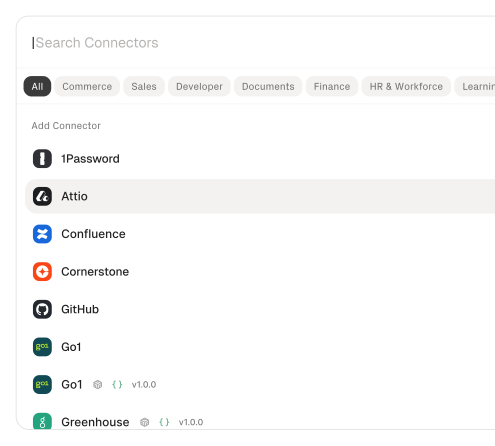
Managed Auth handles credentials across providers
OAuth flows, API keys, and token refresh managed per tenant for every connected ATS and CRM — no custom auth code per recruiting platform.
Search and execute finds the right action
Agent searches StackOne's catalog by natural language and executes the matching ATS or CRM action — no pre-loading thousands of tool definitions. Saves tokens at high-volume sourcing.
Managed Webhooks deliver recruiting events consistently
Normalized event delivery when jobs open, candidates reply, or pipeline stages change across all connected ATS providers — no custom listeners per platform.
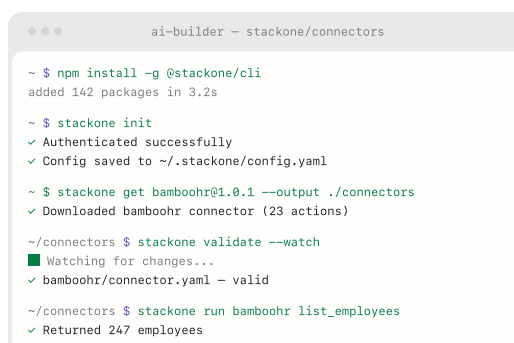
Connector Studio extends to any recruiting platform
Build custom connectors for unsupported ATS tools via REST API configuration with AI-assisted tooling and YAML definitions — no waiting on vendor roadmaps.
Defender blocks prompt injection from candidate data
StackOne Defender screens candidate profile data and resume content for injection attempts before it reaches the agent, preventing manipulation from untrusted text fields.
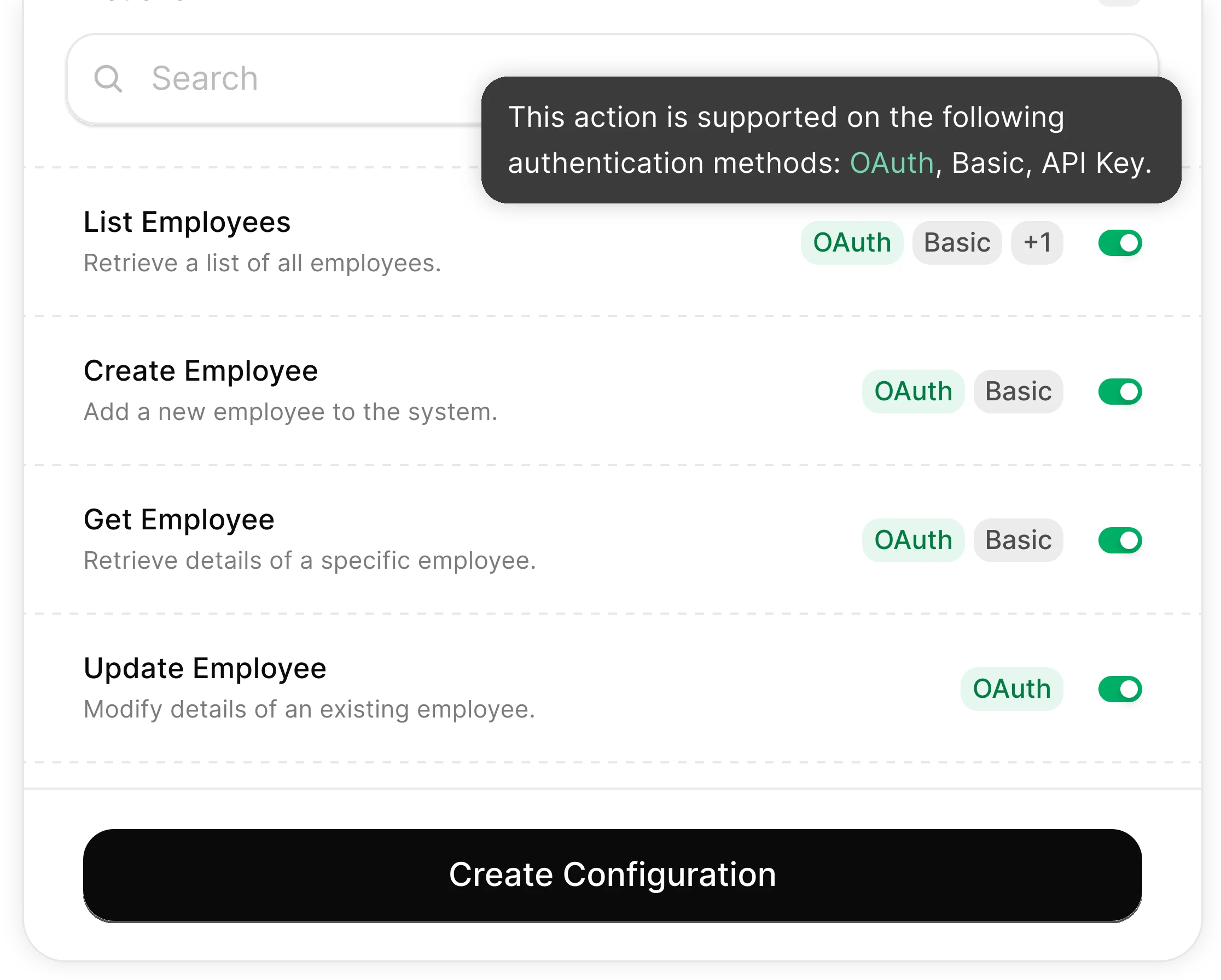
You Control What the Agent Can Do
Scoped permissions define exactly which candidate fields the agent reads and what actions it takes. Full audit trail of every sourcing operation.
Integrates with your entire recruiting stack. Whatever it is.
Connect Any Agent to Automate Candidate Sourcing

Any Agent Framework
Claude, OpenAI, LangChain, Vercel AI SDK, CrewAI, Pydantic AI — StackOne works with every major agent framework out of the box.


Any Agent Builder
Whether you're building with code, a visual builder, or an enterprise platform — StackOne provides the integration layer your agent needs.
Connect Your Agent to Your Recruiting Stack
Start building in minutes. MCP connectors to every system your agent needs.
Frequently Asked Questions
Connect Your Agent to Your Recruiting Stack
Start building in minutes. MCP connectors to every system your agent needs.