


Inkbox MCP Server
for AI Agents
Connect your AI agent to StackOne's Inkbox MCP server and give it 195 MCP tools out of the box. Auth, tool execution, and security all managed.
 StackOne


Coverage
195 Agent Actions
Agents can read, write, delete and run operations in Inkbox. Extend your agent's capabilities with custom actions.

Authentication
Agent Tool Authentication
Per-user OAuth in one call. Your Inkbox MCP server gets session-scoped tokens with zero credentials stored on your infra.
Agent Auth →
Security
Agent Protection
Every Inkbox tool response scanned for prompt injection in milliseconds, with 88.7% accuracy, all running on CPU.
Prompt Injection Defense →
Performance
Max Agent Context. Min Cost.
Free up to 96% of your agent's context window to enhance reasoning and reduce cost, on every Inkbox call.
Tools Discovery →What is the Inkbox MCP Server?
A Inkbox MCP server lets AI agents read and write Inkbox data through the Model Context Protocol, Anthropic's open standard for connecting LLMs to external tools. StackOne's Inkbox MCP server ships with 195 pre-built actions, fully extensible via the Connector Builder, plus managed authentication, prompt injection defense, observability, and agent execution runtime. Connect it from MCP clients like Claude Desktop, Claude Code, Cursor, Goose, and VS Code, or from agent frameworks like OpenAI Agents SDK, LangChain, and Vercel AI SDK.
All Inkbox MCP Tools
Every StackOne action for Inkbox, ready for your agent. Read, write, delete and run operations, scoped to exactly what you need.
A2A Contact Rules
- Create A2A Contact Rule
Create a directional allow/block rule for a peer agent handle.
- List A2A Contact Rules
List one identity's A2A contact rules.
- Update A2A Contact Rule
Change an A2A contact rule's action or direction.
- Delete A2A Contact Rule
Delete an A2A contact rule.
A2A Contexts
- List A2A Contexts
Lists contexts visible to the identity, most recently active first.
- Get A2A Context
Get one A2A context another agent opened toward this identity, with its tasks.
- Update A2A Context
Updates the persistent session name and returns the complete context.
Sent A2A Contexts
- List Sent A2A Contexts
Lists contexts this identity originally opened toward other agents.
- Get Sent A2A Context
Get one A2A context this identity opened, with its tasks.
A2A Tasks
- List A2A Tasks
Lists tasks visible to the identity, newest first.
- Get A2A Task
Get one A2A task this identity received, with its message history.
Brands
- Get Brand
Returns the same brand object with current verification information.
- Update Brand
Replace the organization's 10DLC brand details (full PUT; all required fields must be sent).
- Delete Brand
Delete the organization's 10DLC brand.
Campaigns
- Get Campaign
Returns the campaign object with current review information.
- Update Campaign
Partially update the existing campaign's help message, message flow and sample messages (only these 7 fields; all optional).
- Delete Campaign
Delete the organization's 10DLC campaign (204 No Content).
Contact Communication Policys
- Get Contact Communication Policy
Read a contact's per-address communication policy for one identity.
- Set Contact Communication Policy
Replaces exact-address choices (guarded by expected_revision and observed actions) and optionally the Profile/Memories visibility settings for a contact and identity.
Contacts
- Create Contact
Create a contact in the organization directory.
- Import Contacts
Bulk-import contacts from a vCard body.
- List Contacts
List contacts visible under the caller's contact permissions.
- Get Contact
Fetch a single contact by its UUID.
- Update Contact
Edit a contact; fields you leave out stay unchanged.
- Delete Contact
Delete one contact.
Identitys
- Create Identity
Atomically provisions the identity, its mailbox, and its tunnel in a single transaction.
- Get Identity
Get a single identity with its linked communication channels.
- Update Identity
Update an identity's display name, description, iMessage settings, attached iMessage line, or contact-rule filter modes.
- Delete Identity
Delete an agent identity and its mailbox and tunnel.
Identity Contact Access
- Get Identity Contact Access
Read contact access: email/phone group visibility, contactable addresses, and profile/memories visibility for an identity.
- Update Identity Contact Access
Update contact access for an identity; returns the updated settings.
IMessage Contact Rules
- Create IMessage Contact Rule
Add an allow or block rule for an agent identity.
- List IMessage Contact Rules
List contact rules for an agent identity, newest first.
- Get IMessage Contact Rule
Fetch a single rule by ID.
- Update IMessage Contact Rule
Change action or coverage, or atomically edit one covered side.
- Delete IMessage Contact Rule
Delete an iMessage (phone-number) contact rule.
IMessage Conversations
- List IMessage Conversations
List conversation summaries ordered by most recent message, with latest-message preview and unread count.
- Get IMessage Conversation
Get a single 1:1 or group conversation by ID.
IMessages
- Send IMessage
Send an outbound iMessage.
- List IMessages
List iMessages visible to the caller, newest first, across all of the caller's conversations or narrowed to one.
- Get IMessage
Read a message by UUID, including its current delivery status.
IMessage Reactions
- Send IMessage Reaction
React to a message a human sent in one of your agent's 1:1 or ready group conversations.
- Remove IMessage Reaction
Take back a tapback your agent sent.
IMessage Router Conversations
- List IMessage Router Conversations
List router conversations with cursor pagination.
- Get IMessage Router Conversation
Get one router conversation by ID.
IMessage Routers
- Get IMessage Router
Returns the active organization-owned router line and its configuration.
- Update IMessage Router
Set `contact_sharing_enabled` to `true` to publish the router's display name and optional avatar, or `false` to remove its automatic sharing profile.
Mail Contact Rules
- Create Mail Contact Rule
Create an allow or block rule on an agent identity.
- List Mail Contact Rules
List mail contact rules for an agent identity, newest first.
- Get Mail Contact Rule
Fetch a single contact rule by ID.
- Update Mail Contact Rule
Change a rule's action or coverage, or atomically edit one covered side.
- Delete Mail Contact Rule
Delete an email contact rule.
Mail Drafts
- Create Mail Draft
Create an empty, incomplete, or send-ready draft.
- Send Mail Draft
Validate and send the exact revision.
- List Mail Drafts
List the drafts in one mailbox.
- Get Mail Draft
Get one draft with its bodies, attachments and current generation.
- Update Mail Draft
Partially update the expected revision.
- Delete Mail Draft
Permanently delete the expected revision and free its storage.
Mail Draft Attachments
- Add Mail Draft Attachments
Add one or more attachments to the expected generation.
- Get Mail Draft Attachment
Streams the decoded attachment body with its content type and download filename.
- Remove Mail Draft Attachment
Remove one attachment from a draft.
Mail Import Jobs
- Create Mail Import Job
Start a mailbox import job and get an upload target for the archive file.
- List Mail Import Jobs
List jobs newest first with cursor pagination.
- Get Mail Import Job
Get the current status, counters, timestamps, and any job-level error.
Mail Messages
- Send Mail Message
Compose and send an email from a mailbox.
- List Mail Messages
List messages in a mailbox, newest first, with cursor pagination.
- Get Mail Message
Get a single message with its full body content (plain text and HTML).
Mail Threads
- List Mail Threads
List threads for a mailbox with cursor pagination, ordered by most recent message activity.
- Get Mail Thread
Get a single thread with all its messages (metadata only — no body content) inline.
- Update Mail Thread
Move a mail thread to the inbox, spam or archive folder.
- Delete Mail Thread
Permanently delete a mail thread and its messages.
Notes
- Create Note
Create an organization-wide note.
- List Notes
List notes visible to the caller.
- Get Note
Fetch a single note by ID.
- Update Note
Edit a note's title or body.
- Delete Note
Delete a note.
Texts
- Send Text
Send an outbound message from one of your phone numbers.
- List Texts
List text messages for a phone number, newest first.
- Search Texts
Full-text search across text message bodies for a phone number.
- Get Text
Get a single text message by ID.
- Update Text
Update a text message, for example to mark it as read.
Call Transcripts
- List Call Transcripts
List all transcript segments for a call, ordered by sequence number.
- Search Call Transcripts
Full-text search across all transcript segments for a phone number.
Slack Contact Rules
- Create Slack Contact Rule
Creates a Slack contact rule for an identity with action (allow or block), match_type, and match_target.
- List Slack Contact Rules
Lists Slack contact rules for an identity.
- Get Slack Contact Rule
Reads a single Slack contact rule.
- Update Slack Contact Rule
Changes the action or direction of a Slack contact rule.
- Delete Slack Contact Rule
Delete a Slack contact rule.
Slack Conversations
- List Slack Conversations
List conversations the bot is a member of through the selected workspace connection.
- Get Slack Conversation
Get one Slack conversation by ID.
Slack Messages
- Send Slack Message
Send an idempotent message to a Slack conversation (optionally as a thread reply).
- List Slack Messages
Reads messages live from Slack.
- Get Slack Message
Get one live Slack message by timestamp.
- Update Slack Message
Edit the text of a message the bot posted in Slack.
- Delete Slack Message
Delete a message the bot posted in Slack.
SMS Opt Ins
- List SMS Opt Ins
List the consent rows for your organization, ordered by most recently updated first.
- Get SMS Opt In
Look up the consent state for one recipient under your organization.
Tunnels
- List Tunnels
List all tunnels in the caller's organization.
- Get Tunnel
Fetch a single tunnel by ID.
- Update Tunnel
Update a tunnel's metadata.
Vault Secrets
- Create Vault Secret
Store a new encrypted secret.
- List Vault Secrets
List all secrets (metadata only — no encrypted payloads).
- Get Vault Secret
Get one vault secret with its encrypted payload.
- Update Vault Secret
Update a secret's name, description, or encrypted payload.
Other (91)
- Create A2A Invitation
Invite a customer agent to establish a bidirectional Agent2Agent connection with a fixed peer bundle
- Upload Opt In Evidence
Register a brand first.
- Create Contact With Permissions
Create a contact and configure one agent's access in a single transaction using an admin API key.
- Send IMessage Typing
Show the typing bubble to a 1:1 conversation's recipient — useful while your agent prepares a longer reply.
- Upload IMessage Media
Upload a file and get a media URL to attach to an iMessage.
- Create Or Rotate Identity Signing Key
Create a signing key for this agent identity, or rotate the existing one.
- Import Slack Contacts
Import one page of visible people into your organization's real contacts.
- Add Slack Reaction
Add an emoji reaction to a Slack message.
- Append Slack Task Stream
Add progress updates to an open Slack task stream.
- List Organization A2A Contact Rules
List A2A contact rules for every identity in the organization (admin).
- List A2A Messages
Read and search an identity's A2A message history across every task and context
- Get Current API Key
Return metadata for the API key making the request.
- Export Contacts VCard
Export 1–25 contacts as a single vCard document.
- Export Contact VCard
Download a single contact as a text/vcard; charset=utf-8 file.
- List Identities
List all identities for your organization, newest first.
- Get Identity Channel Status
Get the channel status of an identity.
- List Identity Contact Communication Policies
Preview an identity's saved view of contacts; the identity listing returns items, limit, offset, and has_more.
- List Identity Contact Permissions
List contacts in the selected identity's organization, including contacts hidden from that identity.
- List IMessage Numbers
List the organization's dedicated iMessage lines.
- Get IMessage Onboarding
Fetch iMessage onboarding information for the organization or a specific agent identity.
- Get IMessage Triage Number
Get the iMessage router number and connect command a person texts to reach an agent.
- List Org IMessage Contact Rules
Org-wide aggregate list of iMessage contact rules across every identity.
- List IMessage Assignments
List active iMessage connections, newest first — one row per recipient currently connected to an agent identity through the router or the connect endpoint.
- Get IMessage Conversation Thread
Read one reply thread within a 1:1 or group conversation.
- Get IMessage Thread
Read the stored, visible root and replies using any message in the thread.
- List IMessage Router Messages
List messages in a router conversation with cursor pagination.
- Get IMessage Router Avatar
Get the router avatar.
- List Org Mail Contact Rules
Org-wide aggregate list of mail contact rules across every identity the caller can see.
- List Mailboxes
List all active mailboxes for your organization, newest first.
- Search Mail Messages Org Wide
Search messages across all mailboxes in your organization.
- Search Mailbox Messages
Search messages in a mailbox with full-text search.
- List Mail Threads By Visibility
List threads across all mailboxes the caller can access, ordered by most recent activity (spec has no description; inferred from docs summary).
- List Mail Folders
List the folders containing at least one accessible thread in the mailbox.
- Get Mail Thread By Visibility
Get a single thread with its messages inline (metadata only, no body content).
- List Note Access
List the identities granted access to a note.
- List Calls
List calls for an agent identity, newest first — spans dedicated phone numbers plus shared and dedicated iMessage lines.
- List Call Tool Invocations
List a call's Voice AI tool activity in execution order.
- Get Identity Signing Key Status
Report whether this agent identity has a signing key configured.
- List Slack Archive Messages
Read retained Slack message history in time order.
- Search Slack Archive
Search one Slack workspace's retained messages by keyword.
- Search Slack Identity Archive
Search retained Slack messages across all of an identity's workspaces.
- Get Slack Archive Coverage
Show Slack archive import progress per conversation and thread.
- List Slack Connections
All visible connections for the identity, including disconnected ones.
- List Org Slack Contact Rules
Lists Slack contact rules across every identity in the organization.
- List Slack Conversation Members
List the user IDs of a Slack conversation's members.
- Get Slack Cached Media
Download a cached display image.
- Get Slack Action By Key
Look up a Slack message send by its idempotency key.
- Get Slack Action
Get a Slack message send by its action ID.
- Get Slack Message Context
Read the Slack messages around one message.
- Get Slack Operation By Key
Look up a Slack edit, delete, reaction or stream operation by its idempotency key.
- List Vault Secret Access
List all identity access rules for a secret.
- Update IMessage Router Connect Onboarding
Toggle whether first-contact onboarding is sent when a human connects.
- Set Incoming Call Action
Upsert the inbound-call configuration for an agent identity.
- Set Slack Processing Status
This requests Slack's native agent-session status for a thread.
- Reply To A2A Task
Reply to a received A2A task and move it to a new state.
- Check Agent Signup Status
Check the agent's current claim status, the agent owner's (human's) account state, and the agent's behavioral restrictions.
- Verify Brand SMS OTP
Submit the one-time PIN the customer received via SMS to verify the brand's contact.
- Register Brand
Send a JSON body with your business details.
- Trigger Brand SMS OTP
Send a one-time PIN via SMS to the brand's mobile phone for sole-proprietor brand verification; returns brand_id and reference_id.
- Register Campaign
Send the following JSON fields.
- Resubmit Campaign
Send the **complete campaign registration body**, with the same fields as `POST /campaign`.
- Bulk Delete Contacts
Delete 1–1,000 contacts with an admin API key or a claimed agent API key.
- Preview Contacts Import
Validate a vCard batch and find conflicts with existing contacts before importing it.
- Connect Identity IMessage Number
Attach an existing organization-owned dedicated iMessage number to an identity.
- Disconnect Identity IMessage Number
Detach the dedicated iMessage number from an identity, returning it to shared service.
- Release Identity Phone Number
Release the identity's phone number.
- Connect IMessage Recipient
Create a 1:1 connection and submit its opening message in one request.
- Disconnect IMessage Recipient
Disconnect the active connection for an identity and recipient.
- Check IMessage Messaging Capability
Check which messaging service is currently available for an E.164 phone number.
- Claim IMessage Number
Claims one unattached dedicated line for the organization.
- Release IMessage Assignment
Disconnect a recipient from an agent identity.
- Mark IMessage Read
Send a read receipt to the human — they see "Read" under their latest message — and mark the conversation's inbound messages as read.
- Cancel Mail Import Job
Cancel a pending, queued or running mailbox import.
- Reissue Mail Import Upload URL
Issue a replacement upload target when the previous one lapses before the file is uploaded.
- Start Mail Import Job
Validate the completed upload and queue the job.
- Reply All Mail Message
Reply to every visible participant on a stored message.
- Forward Mail Message
Forward a stored message to new recipients.
- Grant Note Access
Grant an agent identity read + CRUD access to a note.
- Revoke Note Access
Revoke an identity's access to a note.
- Place Call
Initiate an outbound call.
- Provision Phone Number
Provision a new phone number for your organization.
- Release Phone Number
Release a phone number from your organization.
- Start Slack Installation
Requires an organization member in the Console, organization admin API key, or the identity’s claimed agent key.
- Disconnect Slack Connection
Disconnect an identity from a Slack workspace.
- Open Slack Conversation
Opens or resumes a DM or group DM in the selected workspace.
- Start Slack Task Stream
Show native task progress in an existing Slack thread and close the stream when work finishes
- Stop Slack Task Stream
Close a Slack task stream.
- Opt In Recipient
Mark a recipient as opted in.
- Opt Out Recipient
Mark a recipient as opted out.
- Grant Vault Secret Access
Grant an agent identity access to a specific secret.
- Revoke Vault Secret Access
Revoke an identity's access to a secret.
Inkbox AI Agent Use Cases
Connect your AI agent to Inkbox and help your team scale the sales operations they run by hand today.
Use StackOne to connect your AI agent to your CRM, email, and calendar tools to automate post-demo follow-up.
ViewUse StackOne to connect your AI agent to your CRM, email, and calendar tools to automate deal risk scoring and pipeline alerts.
ViewUse StackOne to connect your AI agent to your CRM, sales engagement, and messaging tools to automate outbound prospecting.
ViewSet Up Your Inkbox MCP Server in Minutes
One endpoint. Any framework. Your agent is talking to Inkbox in under 10 lines of code.
Agent Frameworks


 JSON
{
  "mcpServers": {
    "stackone": {
      "command": "npx",
      "args": [
        "-y",
        "mcp-remote@latest",
        "https://api.stackone.com/mcp?x-account-id=<account_id>",
        "--header",
        "Authorization: Basic <YOUR_BASE64_TOKEN>"
      ]
    }
  }
}
Check More productivity-collaboration MCP Servers
Platform Resources

Comparing BM25, TF-IDF, and Hybrid Search for MCP Tool Discovery
Benchmarking BM25, TF-IDF, and hybrid search for MCP tool discovery across 916 tools. The 80/20 TF-IDF/BM25 hybrid hits 21% Top-1 accuracy in under 1ms.
10 min
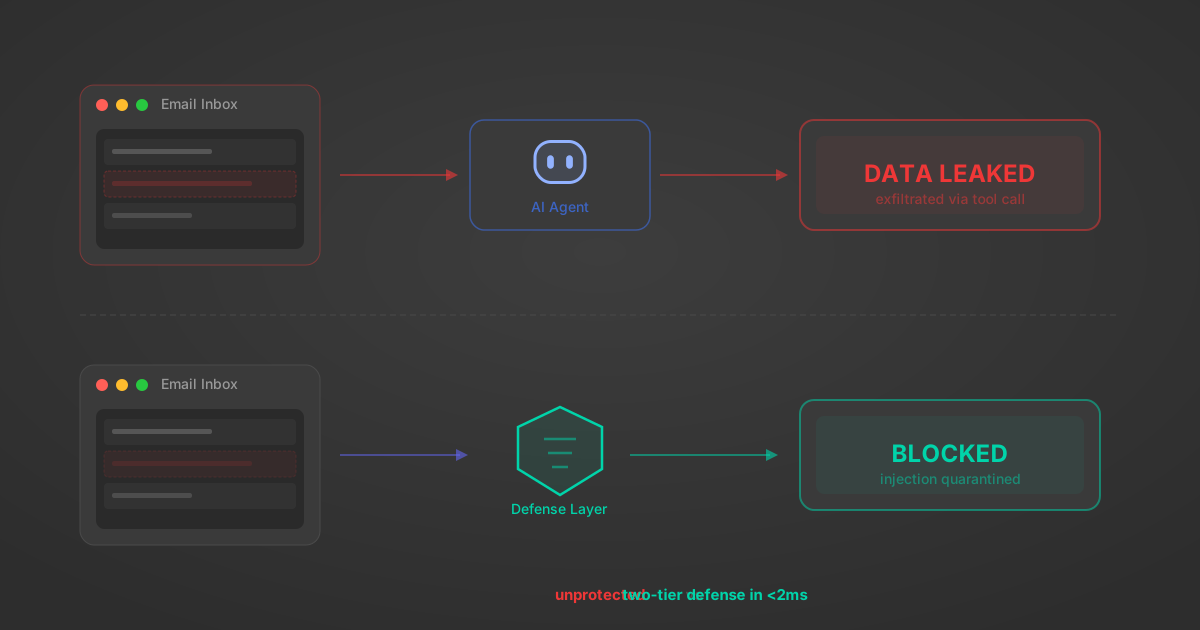
Indirect Prompt Injection Defense for MCP Tools: A Technical Guide
MCP tools that read emails, CRM records, and tickets are indirect prompt injection vectors. Here's how we built a two-tier defense that scans tool results in ~11ms.
12 min

MCP vs A2A: Architecture, Security, and When to Use Each
MCP vs A2A: what each protocol standardizes, how they differ, their shared security risks including indirect prompt injection, and when to use one, both, or a hybrid architecture.
12 min
MCP vs API: What Hundreds of Connector Builds Taught Us
MCP wraps APIs, it doesn't replace them. After building hundreds of connectors that serve both, here's when each approach wins.
14 min read
Inkbox MCP Server FAQ
Does StackOne have a Inkbox MCP server?
Inkbox MCP server vs direct API integration: what's the difference?
How does Inkbox authentication work for AI agents?
origin_owner_id.Are Inkbox MCP tools vulnerable to prompt injection?
What is the context bloat of a Inkbox agent and how do I avoid it?
Can I limit which actions my Inkbox agent can access?
Can I create custom agent actions for my Inkbox MCP server?
When should I NOT use a Inkbox MCP server?
What AI frameworks and AI clients does the StackOne Inkbox MCP server support?
Put your AI agents to work
All the tools you need to build and scale AI agent integrations, with best-in-class connectivity, execution, and security.