
Egnyte MCP Server
for AI Agents
Connect your AI agent to StackOne's Egnyte MCP server and give it 38 MCP tools out of the box. Auth, tool execution, and security all managed.
 StackOne





Coverage
38 Agent Actions
Create, read, update, and delete across Egnyte — and extend your agent's capabilities with custom actions.

Authentication
Agent Tool Authentication
Per-user OAuth in one call. Your Egnyte MCP server gets session-scoped tokens with zero credentials stored on your infra.
Agent Auth →
Security
Agent Protection
Every Egnyte tool response scanned for prompt injection in milliseconds — 88.7% accuracy, all running on CPU.
Prompt Injection Defense →
Performance
Max Agent Context. Min Cost.
Free up to 96% of your agent's context window to enhance reasoning and reduce cost, on every Egnyte call.
Tools Discovery →What is the Egnyte MCP Server?
A Egnyte MCP server lets AI agents read and write Egnyte data through the Model Context Protocol — Anthropic's open standard for connecting LLMs to external tools. StackOne's Egnyte MCP server ships with 38 pre-built actions, fully extensible via the Connector Builder — plus managed authentication, prompt injection defense, observability, and agent execution runtime. Connect it from MCP clients like Claude Desktop, Claude Code, Cursor, Goose, and VS Code, or from agent frameworks like OpenAI Agents SDK, LangChain, and Vercel AI SDK.
All Egnyte MCP Tools
Every action from Egnyte's API, ready for your agent. Create, read, update, and delete — scoped to exactly what you need.
Comments
- Add Comment
Add a comment (note) to a file or folder in Egnyte, identified by its absolute path.
- List Comments
List comments associated with a file or folder. Filter by path, ISO 8601 time window, and paginate with offset/count.
- Get Comment
Retrieve the details of a single comment by its UUID.
- Delete Comment
Delete a comment identified by its UUID.
File Content By Paths
- Upload File Content By Path
Upload a file's binary content to the given Egnyte path. Creates the file if it does not exist; overwrites it if it does.
- Download File Content By Path
Download the binary content of a file at the given Egnyte path. Optionally scope the download to a specific file version.
Groups
- Create Group
Create a new group on the Egnyte domain with the given displayName and initial member list.
- List Groups
List groups on the Egnyte domain. Supports SCIM-style filter syntax on displayName and paginates via startIndex/count.
- Get Group
Retrieve the details of a group by its groupId, including its displayName and member list.
- Delete Group
Delete a group by its groupId.
Link (v1)s
- Create Link (v1)
Create a shareable file, folder, or upload link for a given path. Configure accessibility (anyone / password / domain / recipients), optional password, expiry, click limit, notification, and recipient list.
- Get Link (v1)
Retrieve the details of a shareable link by its linkId.
- Delete Link (v1)
Delete a shareable link by its linkId.
Users
- Create User
Create a new user on the Egnyte domain. Requires userName, email, name (givenName + familyName), active flag, authType, and userType.
- List Users
List users on the Egnyte domain. Supports SCIM-style filter expressions, 1-based startIndex pagination, and count up to 100.
- Get User
Retrieve a single Egnyte user by their numeric user ID.
- Update User
Partially update an Egnyte user. Any subset of email, name (givenName/familyName), active, authType, userType, and other profile fields can be changed. At least one updatable field must be provided; empty PATCH bodies are rejected with USER_ERROR.
- Delete User
Delete an Egnyte user by their numeric user ID.
Other (20)
- Get Events Cursor
Fetch the current event stream cursor for this Egnyte tenant. Returns the latest and oldest event IDs along with a timestamp. Call this once to establish a starting cursor before polling `get_events_v2`.
- List Events (v2)
Poll the Egnyte event stream for file system, note, and permission changes starting after a given cursor ID. Wait at least 5 minutes between polls to avoid rate-limiting.
- Get File Or Folder Metadata (v2)
Retrieve metadata for a file or folder at the given Egnyte path. Optionally list folder contents, include permissions, locks, collaboration info, and custom metadata.
- Get File Or Folder Metadata By ID
Retrieve metadata for a file or folder using its persistent ID (group_id for files, folder_id for folders).
- Get Folder Statistics By ID
Retrieve aggregate statistics (item counts, sizes) for a folder identified by its folder_id.
- Download File Content By ID
Download the binary content of a file identified by its persistent group_id. Optionally scope the download to a specific file version.
- List Links (v2)
List shareable file and folder links on the domain. Filter by path, username, link type, or accessibility. Paginate with offset/count.
- Get Effective Permissions For User
Retrieve the effective folder permissions for a specific user on a specific folder path. Both `username` and `folder` are required.
- Search Files And Folders (v2)
Search for files and folders across the Egnyte domain using keywords and/or custom metadata filters. Supports pagination, time window filtering, sort, and field/similarity filters.
- Get User Info
Return basic information (username, email, first_name, last_name, phone, is_admin, is_service_account) about the user associated with the current OAuth access token. Used as the connection health-check.
- List Trash Contents (v2)
List items in the Egnyte trash with extended sort options and a deletedBy/date-range filter. Only administrators or power users with trash management privileges can access this endpoint.
- Delete File Or Folder (v2)
Delete a file or folder at the given path. Optionally scope deletion to a single file version via `entry_id`.
- Delete File Or Folder By ID
Delete a file or folder identified by its persistent ID (group_id / folder_id). Optionally scope deletion to a single file version.
- File Or Folder Operation (v2)
Perform a filesystem operation on a file or folder at the given path — create a folder, move, copy, rename, lock, or unlock.
- File Or Folder Operation By ID
Move or copy a file or folder identified by its persistent ID (group_id / folder_id).
- Chunked Upload By File ID
Upload a single chunk of a large file (identified by its persistent group_id) as part of a chunked upload. Recommended chunk size is 100 MB; min 10 MB, max 1 GB. All chunks except the last must be the same size.
- Modify Folder Options
Update folder-level configuration such as description, link behaviour, move/delete restrictions, permission inheritance, and email notifications for a folder at the specified path.
- Replace Group
Fully replace a group — set its displayName and the complete member roster in one call. Any existing member NOT in the supplied list is dropped.
- Partially Update Group
Partially update a group — rename via `displayName` or remove members incrementally via a `members` array of `{value, operation:'delete'}` objects. Egnyte does NOT accept SCIM 2.0 PatchOp `schemas`/`Operations` arrays here; fields are sent directly.
- Restore Or Purge Trash Items
Restore items from the Egnyte trash back to their original location, or permanently delete (purge) them. Provide the action and up to 10 trash item IDs.
Set Up Your Egnyte MCP Server in Minutes
One endpoint. Any framework. Your agent is talking to Egnyte in under 10 lines of code.
Agent Frameworks


 JSON
JSON{
"mcpServers": {
"stackone": {
"command": "npx",
"args": [
"-y",
"mcp-remote@latest",
"https://api.stackone.com/mcp?x-account-id=<account_id>",
"--header",
"Authorization: Basic <YOUR_BASE64_TOKEN>"
]
}
}
}Platform Resources
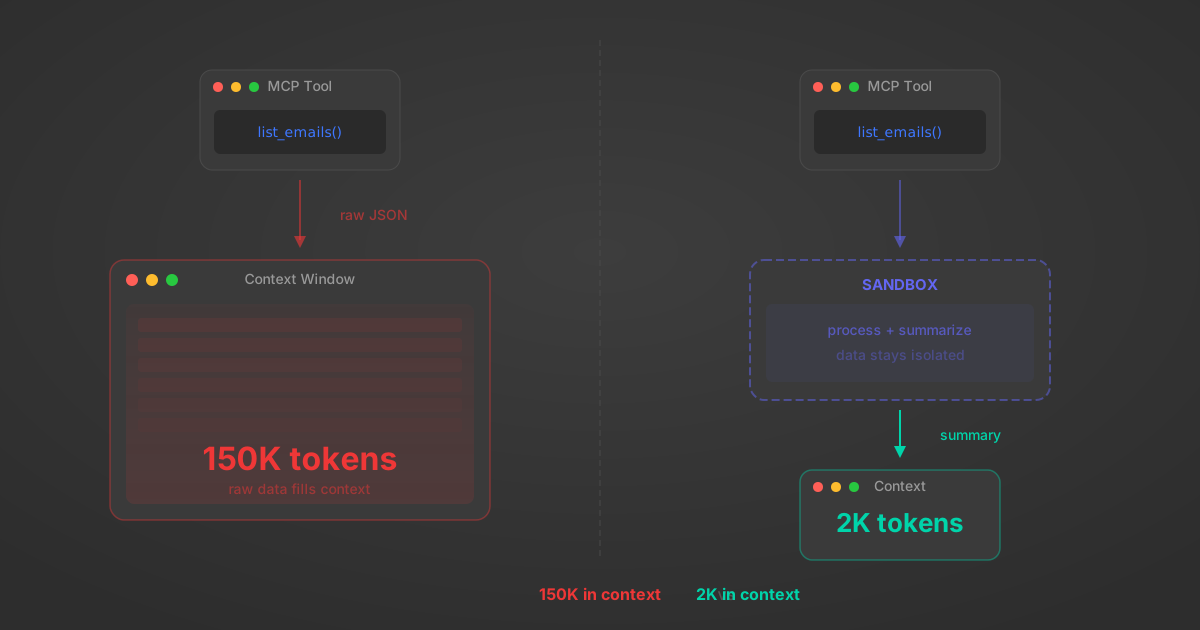
MCP Code Mode: Keeping Tool Responses Out of Agent Context
Anthropic's code_execution processes data already in context. Custom MCP code mode keeps raw tool responses in a sandbox. 14K tokens vs 500.
11 min
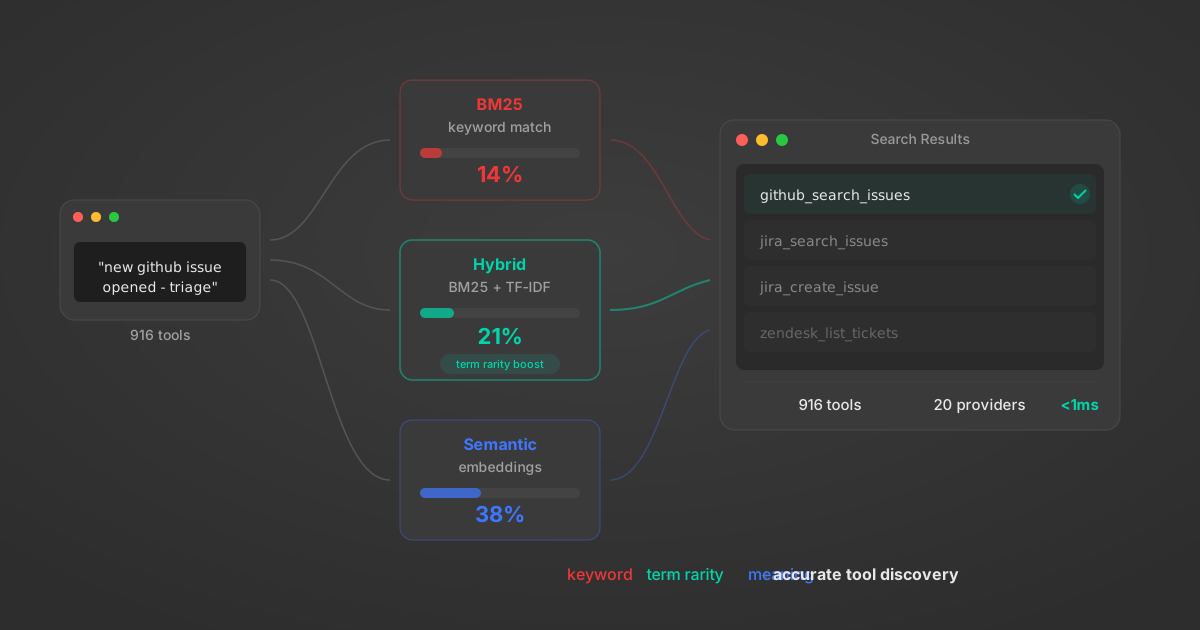
Comparing BM25, TF-IDF, and Hybrid Search for MCP Tool Discovery
Benchmarking BM25, TF-IDF, and hybrid search for MCP tool discovery across 916 tools. The 80/20 TF-IDF/BM25 hybrid hits 21% Top-1 accuracy in under 1ms.
10 min
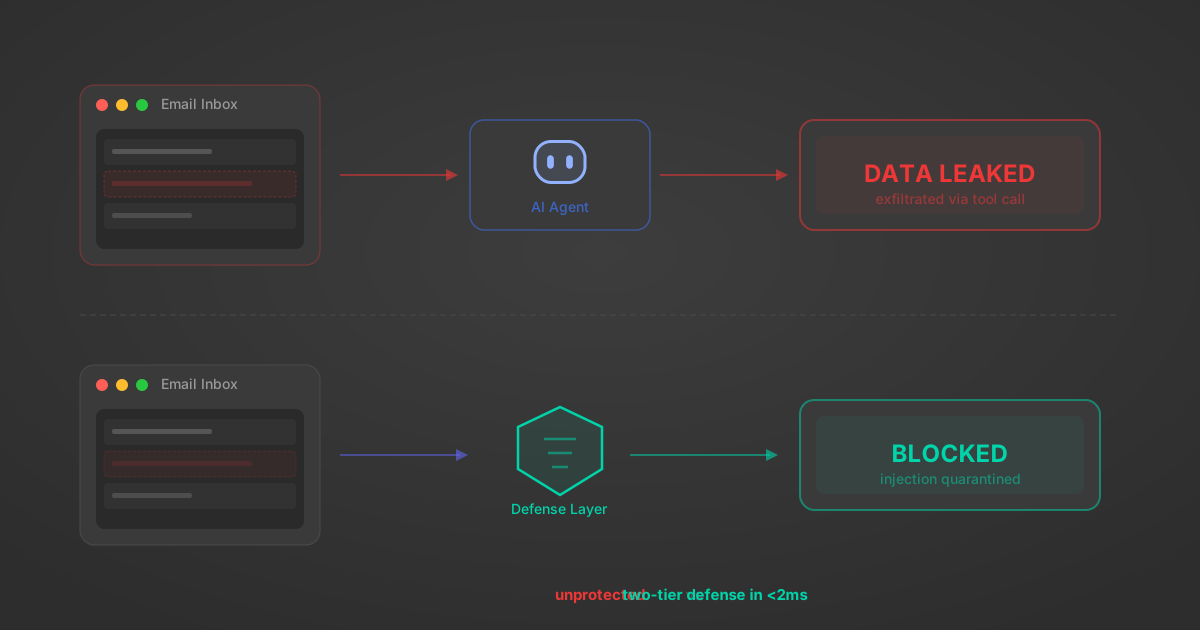
Indirect Prompt Injection Defense for MCP Tools: A Technical Guide
MCP tools that read emails, CRM records, and tickets are indirect prompt injection vectors. Here's how we built a two-tier defense that scans tool results in ~11ms.
12 min
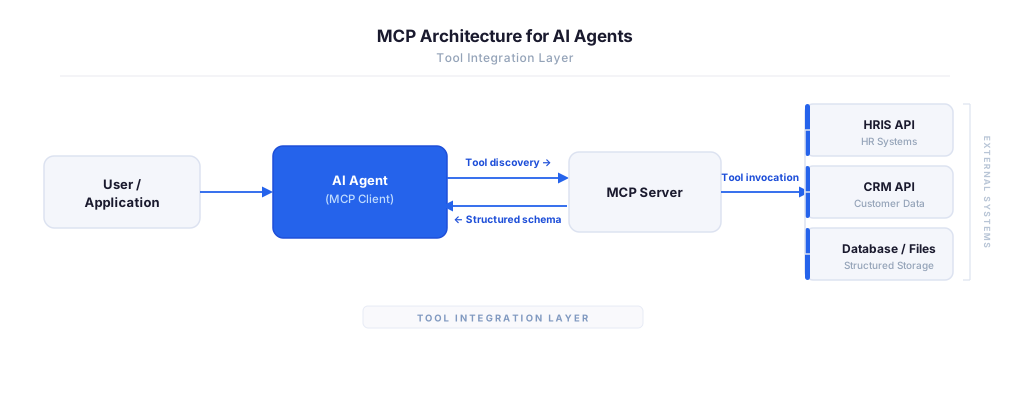
MCP vs A2A: Architecture, Security, and When to Use Each
MCP vs A2A: what each protocol standardizes, how they differ, their shared security risks including indirect prompt injection, and when to use one, both, or a hybrid architecture.
12 min
MCP vs API: What Hundreds of Connector Builds Taught Us
MCP wraps APIs, it doesn't replace them. After building hundreds of connectors that serve both, here's when each approach wins.
14 min read
Egnyte MCP Server FAQ
Does StackOne have a Egnyte MCP server?
Egnyte MCP server vs direct API integration — what's the difference?
How does Egnyte authentication work for AI agents?
origin_owner_id.Are Egnyte MCP tools vulnerable to prompt injection?
What is the context bloat of a Egnyte agent and how do I avoid it?
Can I limit which actions my Egnyte agent can access?
Can I create custom agent actions for my Egnyte MCP server?
When should I NOT use a Egnyte MCP server?
What AI frameworks and AI clients does the StackOne Egnyte MCP server support?
Put your AI agents to work
All the tools you need to build and scale AI agent integrations, with best-in-class connectivity, execution, and security.