Post-Demo Follow-Up
Close More Deals, Faster
Use StackOne to connect your AI agent to your CRM, email, and calendar tools to automate post-demo follow-up.



AI Agents
Connect
MCP and A2A to REST, SOAP, and proprietary APIs.
Optimize
Tool discovery, data shaping, and reliable execution.
Secure
Scoped permissions, audit trails, and observability.
StackOne Integration Layer


 StackOne Integration Layer
Connect
200+ connectors, build your own, and multi-protocol support.
Optimize
Context, token, and speed optimization infrastructure.
Secure
Permissions API and prompt injection protection.
What Can AI Agents Do for Post-Demo Follow-Up?
Your agent detects completed demos, retrieves meeting notes, sends personalized follow-ups, logs everything to CRM, and notifies the rep.
Detect Demo Completion
Monitor Google Calendar, Outlook Calendar, or Calendly for completed demo meetings and trigger the follow-up workflow automatically.
Extract Key Details
Parse attendee names, pain points discussed, objections raised, and agreed next steps from the retrieved notes to personalize the follow-up.
Log to CRM
Log the meeting as a completed activity on the deal record in Salesforce or HubSpot, with the summary and key discussion points attached.
Create Tasks & Update Pipeline
Create follow-up tasks for the rep based on agreed next steps and advance the deal stage in the CRM pipeline automatically.
Notify the Rep
Confirm via Slack or Microsoft Teams that the follow-up was sent, CRM was updated, and tasks were created.
Detect Demo Completion
Monitor Google Calendar, Outlook Calendar, or Calendly for completed demo meetings and trigger the follow-up workflow automatically.
Extract Key Details
Parse attendee names, pain points discussed, objections raised, and agreed next steps from the retrieved notes to personalize the follow-up.
Log to CRM
Log the meeting as a completed activity on the deal record in Salesforce or HubSpot, with the summary and key discussion points attached.
Send Personalized Follow-Up
Generate and send a personalized follow-up email via Gmail or Outlook incorporating specific topics discussed and proposed next steps.
Create Tasks & Update Pipeline
Create follow-up tasks for the rep based on agreed next steps and advance the deal stage in the CRM pipeline automatically.
Notify the Rep
Confirm via Slack or Microsoft Teams that the follow-up was sent, CRM was updated, and tasks were created.
Why Building a Good Post-Demo Follow-Up Agent Is Hard
Connecting CRM, Calendar, and Meeting Tools
The agent needs connectors to Salesforce, HubSpot, Gong, Fireflies, Google Calendar, Outlook, and Gmail. Building and maintaining each one — auth, pagination, rate limits — is a massive lift that compounds with every new customer's sales stack.
Multi-Tenant Auth Across Sales Rep Accounts
Each rep authenticates to their own CRM instance, mailbox, and calendar. Managing OAuth tokens, refresh cycles, and permission scopes per tenant without credential leakage is a significant infrastructure burden.
Token Cost and Tool Discovery at Scale
Without search-first architecture, the agent pre-loads every CRM, email, and calendar action definition into its context window, burning tokens and money. This compounds quickly across high-volume sales teams running dozens of demos daily.
Untrusted Transcript Data Risks Prompt Injection
Meeting transcripts from external participants contain uncontrolled text. Without a guard, injected instructions in transcript content could manipulate the agent into wrong CRM writes or unauthorized email sends.
How StackOne Makes Post-Demo Follow-Up Agents Possible
Everything your follow-up agent needs to detect demos, retrieve notes, update CRM, and send emails — with the controls IT demands.
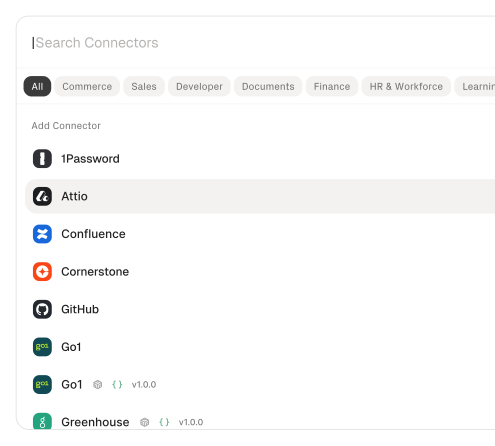
200+ connectors with 10K+ agent-optimized actions
Pre-built connectors for Salesforce, HubSpot, Gong, Fireflies, Google Calendar, Outlook, and Gmail with agent instructions for each provider's native actions.
Managed Auth handles per-rep OAuth at scale
Stores and refreshes OAuth tokens per sales rep, per tool, per tenant — no custom token management or credential isolation infrastructure required.
Search and execute finds the right action
Agent searches StackOne's action catalog by natural language and executes the matching CRM or email action — no pre-loading thousands of tool definitions.
Managed Webhooks deliver demo completion events
StackOne subscribes to calendar and CRM events with automatic delivery and retries across providers, replacing custom polling infrastructure with reliable triggers.
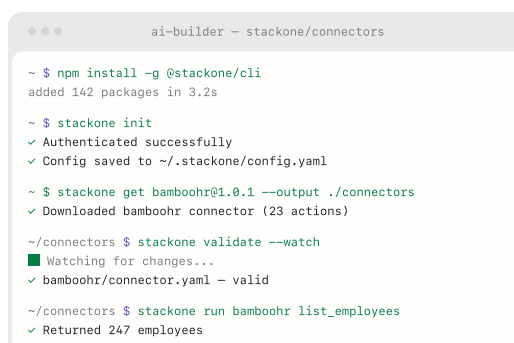
Connector Studio extends to any system
Build custom connectors for unsupported CRMs or meeting-intelligence tools via REST, SOAP, or GraphQL — no waiting on vendor support.
Defender blocks prompt injection from transcripts
StackOne Defender inspects every agent action before execution, guarding against injected instructions in meeting transcripts that could trigger unauthorized CRM writes or email sends.
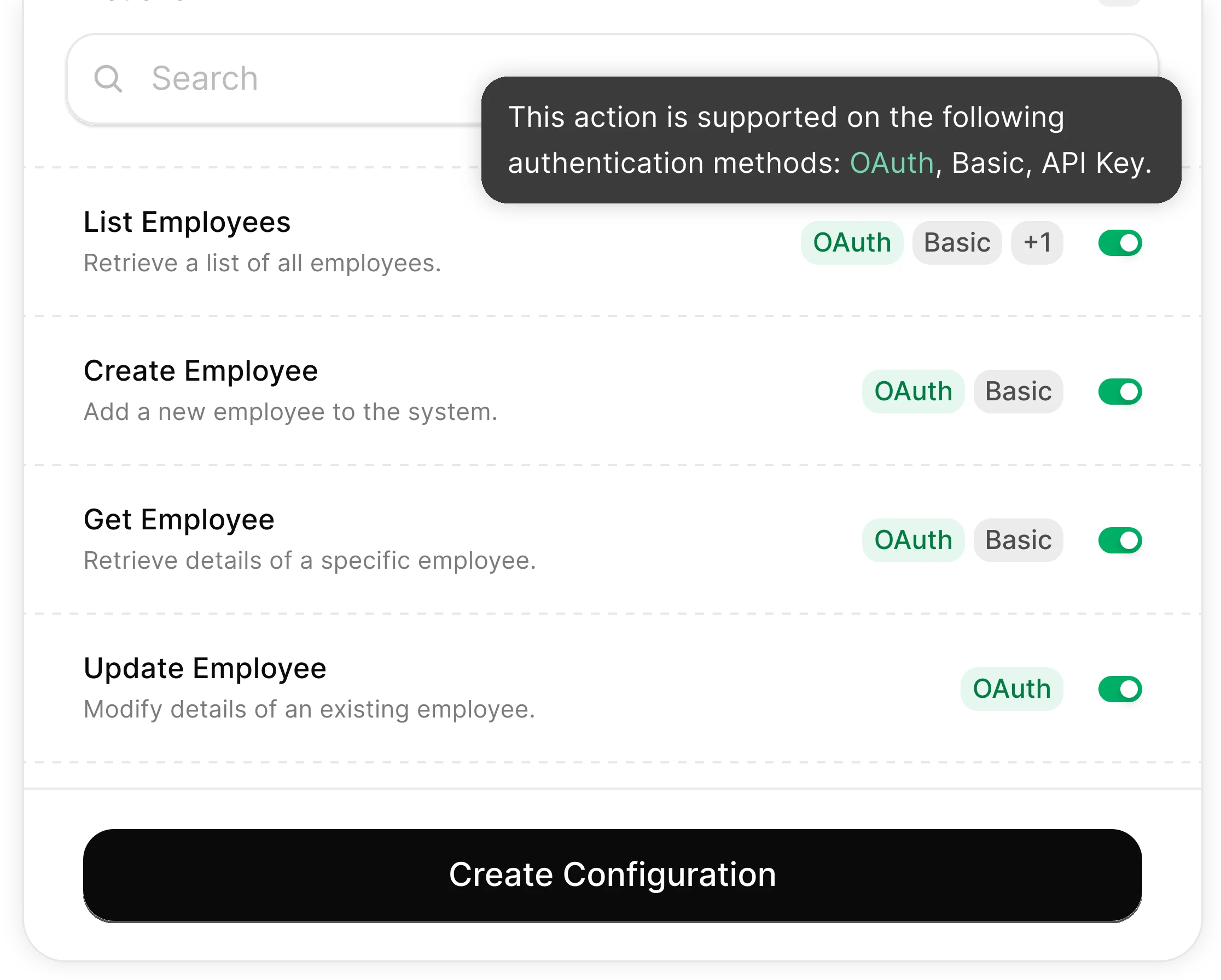
You Control What the Agent Can Do
Scoped permissions define exactly which CRM fields the agent reads, which emails it can send, and which deal stages it can update. Full audit trail of every operation.
Integrates with your entire sales stack. Whatever it is.
Connect Any Agent to Automate Post-Demo Follow-Up

Any Agent Framework
Claude, OpenAI, LangChain, Vercel AI SDK, CrewAI, Pydantic AI — StackOne works with every major agent framework out of the box.


Any Agent Builder
Whether you're building with code, a visual builder, or an enterprise platform — StackOne provides the integration layer your agent needs.
Connect Your Agent to Your Sales Stack
Start building in minutes. MCP connectors to every system your agent needs.
Frequently Asked Questions
Connect Your Agent to Your Sales Stack
Start building in minutes. MCP connectors to every system your agent needs.