
InvGate Asset Management MCP Server
for AI Agents
Connect your AI agent to StackOne's InvGate Asset Management MCP server and give it 64 MCP tools out of the box. Auth, tool execution, and security all managed.
 StackOne






Coverage
64 Agent Actions
Create, read, update, and delete across InvGate Asset Management — and extend your agent's capabilities with custom actions.

Authentication
Agent Tool Authentication
Per-user OAuth in one call. Your InvGate Asset Management MCP server gets session-scoped tokens with zero credentials stored on your infra.
Agent Auth →
Security
Agent Protection
Every InvGate Asset Management tool response scanned for prompt injection in milliseconds — 88.7% accuracy, all running on CPU.
Prompt Injection Defense →
Performance
Max Agent Context. Min Cost.
Free up to 96% of your agent's context window to enhance reasoning and reduce cost, on every InvGate Asset Management call.
Tools Discovery →What is the InvGate Asset Management MCP Server?
A InvGate Asset Management MCP server lets AI agents read and write InvGate Asset Management data through the Model Context Protocol — Anthropic's open standard for connecting LLMs to external tools. StackOne's InvGate Asset Management MCP server ships with 64 pre-built actions, fully extensible via the Connector Builder — plus managed authentication, prompt injection defense, observability, and agent execution runtime. Connect it from MCP clients like Claude Desktop, Claude Code, Cursor, Goose, and VS Code, or from agent frameworks like OpenAI Agents SDK, LangChain, and Vercel AI SDK.
All InvGate Asset Management MCP Tools
Every action from InvGate Asset Management's API, ready for your agent. Create, read, update, and delete — scoped to exactly what you need.
Assets
- Create Asset
Create an asset
- List Assets
Retrieves information for assets
- Get Asset
Retrieves information for a specific asset identified by its ID
- Update Asset
Update an asset entirely (all the attributes at the same time)
Chromebooks
- List Chromebooks
Get a list of Chromebooks
- Get Chromebook
Get a specific Chromebook by its ID
Cloud Assets
- List Cloud Assets
Retrieves a list of cloud assets (AWS, Azure, GCP)
- Get Cloud Asset
Retrieves a specific cloud asset by ID
Computers
- List Computers
List computers
- Get Computer
Retrieve a computer
Cost Centers
- Create Cost Center
Creates a new cost center
- List Cost Centers
Retrieves information for cost centers
- Get Cost Center
Retrieves information for a specific cost center identified by its ID
- Update Cost Center
Replaces or updates the information for a specific cost center identified by its ID
- Delete Cost Center
Deletes the specified cost center identified by its ID
Custom Field Values
- List Custom Field Values
Retrieves a list of custom fields values
- Get Custom Field Value
Retrieves detailed information about the custom field value or values and associated configuration item
- Set Custom Field Value
Upserts (set-if-missing, update-if-present) the value of a single-value custom field for a specific configuration item. The composite key (`custom_field_id` + `ci_id`) identifies the entry — there is no standalone record ID. Synced-inventory-attribute fields (e.g. MAC Address) write through to the CI's native attribute — re-read via `get_asset`, NOT via `list_custom_field_values_cis`. Only works on manually-sourced CIs; agent-discovered CIs reject writes.
Database Systems
- List Database Systems
Retrieves a list of database systems (Database Instances and Databases)
- Get Database System
Retrieves a specific database system by its ID
Financials
- List Financials
Retrieves financial information for assets
- Get Financial
Retrieves financial information for a specific asset
- Update Financial
Updates the financial information for a specific asset
Manufacturers
- List Manufacturers
Retrieves information for manufacturers
- Get Manufacturer
Retrieves information for a specific manufacturer identified by its ID
Persons
- Create Person
Creates a new person
- Get Person
Retrieves information for a specific person identified by its ID
- Update Person
Replaces or updates the properties for a specific person identified by its ID
- Delete Person
Deletes the specified person identified by its ID
Purchase Orders
- Create Purchase Order
Creates a new purchase order
- List Purchase Orders
Retrieves purchase orders
- Get Purchase Order
Retrieves a specific purchase order identified by its ID
Servers
- List Servers
List servers
- Get Server
Retrieve a server
Tags
- Create Tag
Creates a tag
- List Tags
Lists tags
- Get Tag
Retrieves a tag
Vendor Contacts
- Create Vendor Contact
Creates a new contact for a vendor
- List Vendor Contacts
Retrieves the external contact persons that belong to a specific VENDOR (requires a vendor_id). NOT for internal people/employees — to look up or update a person by name use list_people / patch_people.
- Get Vendor Contact
Retrieves information for a specific contact from a vendor identified by its ID
- Delete Vendor Contact
Deletes a contact for a vendor, identified by its ID
Vendors
- Create Vendor
Creates a new vendor
- List Vendors
Retrieves a paginated list of vendors. NOTE - there is NO server-side name/company_name filter; the only query parameter is `page`. To resolve a vendor by name, page through the list and match `company_name` client-side (the vendor's name is in `company_name`, NOT a `name` field).
- Get Vendor
Retrieves information for a specific vendor identified by its ID
- Update Vendor
Replaces or updates the information for a specific vendor identified by its ID
- Delete Vendor
Deletes the specified vendor identified by its ID
Other (18)
- Upload Attachment
Attach a file (binary, multipart upload) to one or more CIs.
- List Asset Types
List asset types
- List Assets (Detailed)
List assets with information about related properties
- Get Computer Remote Desktop Integrations
Retrieve a computer's remote desktop integrations
- List Custom Fields
Retrieves information for custom fields settings
- List Financials (Detailed)
Retrieves detailed financial information for assets
- List People
Retrieves information for persons
- List People (Detailed)
Retrieves detailed information for people
- Get Server Remote Desktop Integrations
Retrieve a server's remote desktop integrations
- Set Multi-Value Custom Field
Sets multiple values on a custom field configured to allow multiple values. ⚠ Prerequisite: the target custom field MUST be configured with "allow multiple values" in the InvGate admin console — otherwise the endpoint returns HTTP 400 "This field does not allow for multiple values." Account-level configuration, not a connector feature flag.
- Patch Asset
Update an asset partially (just some attributes)
- Patch Cost Center
Partially updates the information for a specific cost center identified by its ID, without affecting the entire entity
- Patch Financial
Partially update the financial information for a specific asset, without impacting the entire resource
- Patch Person
Partially updates an internal person/employee by ID — including their contact info (email, phone, cellphone). Use this to update a named person's contact details (first resolve the id via list_people, filtering by name/email). NOT for a vendor's external contacts (use patch_vendor_contact for those).
- Assign Tags To CIs
Assigns tags to CIs
- Unassign Tags From CIs
Unassigns tags to CIs
- Patch Vendor
Partially updates the information for a specific vendor identified by its ID, without affecting the entire entity
- Patch Vendor Contact
Updates a contact for a vendor, identified by its ID
Set Up Your InvGate Asset Management MCP Server in Minutes
One endpoint. Any framework. Your agent is talking to InvGate Asset Management in under 10 lines of code.
Agent Frameworks


 JSON
JSON{
"mcpServers": {
"stackone": {
"command": "npx",
"args": [
"-y",
"mcp-remote@latest",
"https://api.stackone.com/mcp?x-account-id=<account_id>",
"--header",
"Authorization: Basic <YOUR_BASE64_TOKEN>"
]
}
}
}Platform Resources
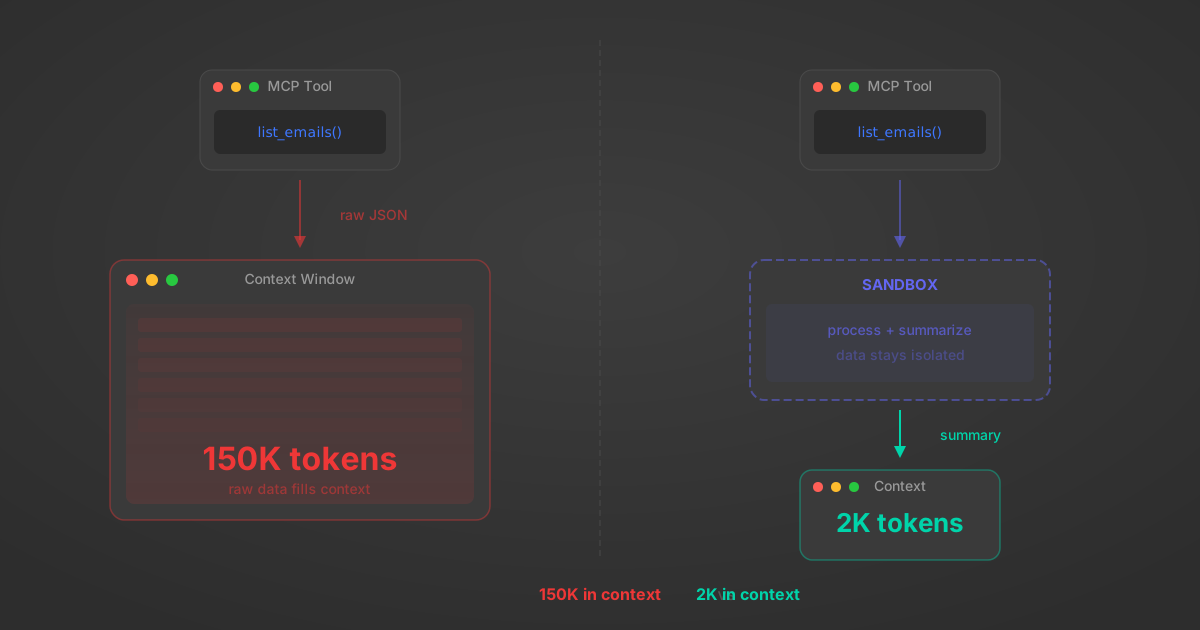
MCP Code Mode: Keeping Tool Responses Out of Agent Context
Anthropic's code_execution processes data already in context. Custom MCP code mode keeps raw tool responses in a sandbox. 14K tokens vs 500.
11 min
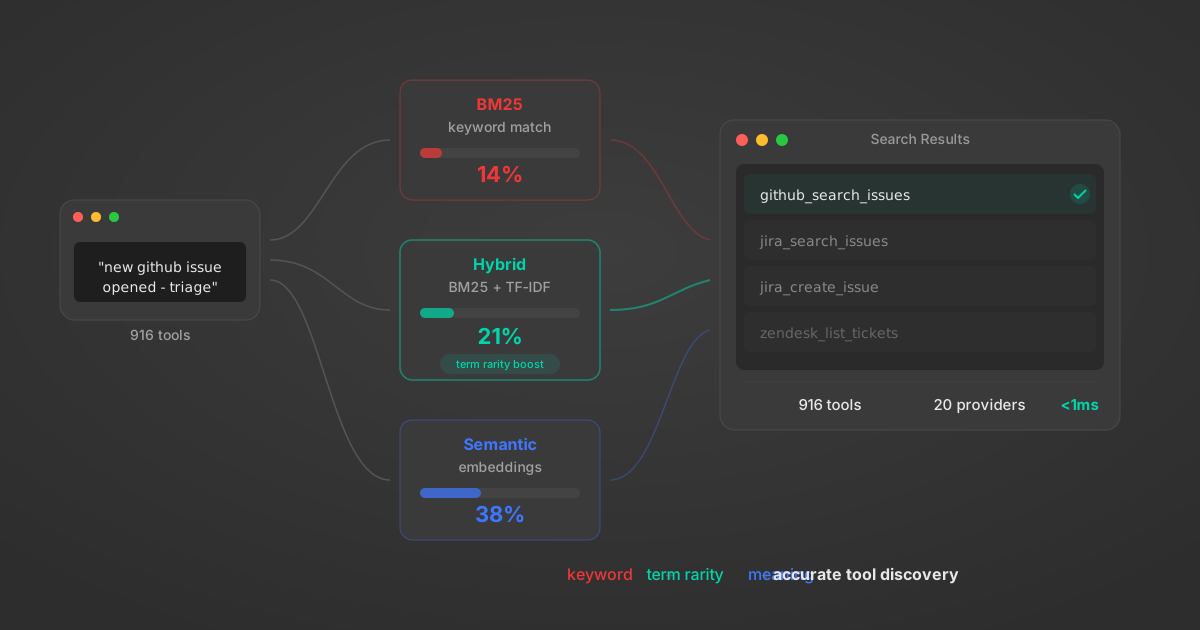
Comparing BM25, TF-IDF, and Hybrid Search for MCP Tool Discovery
Benchmarking BM25, TF-IDF, and hybrid search for MCP tool discovery across 916 tools. The 80/20 TF-IDF/BM25 hybrid hits 21% Top-1 accuracy in under 1ms.
10 min
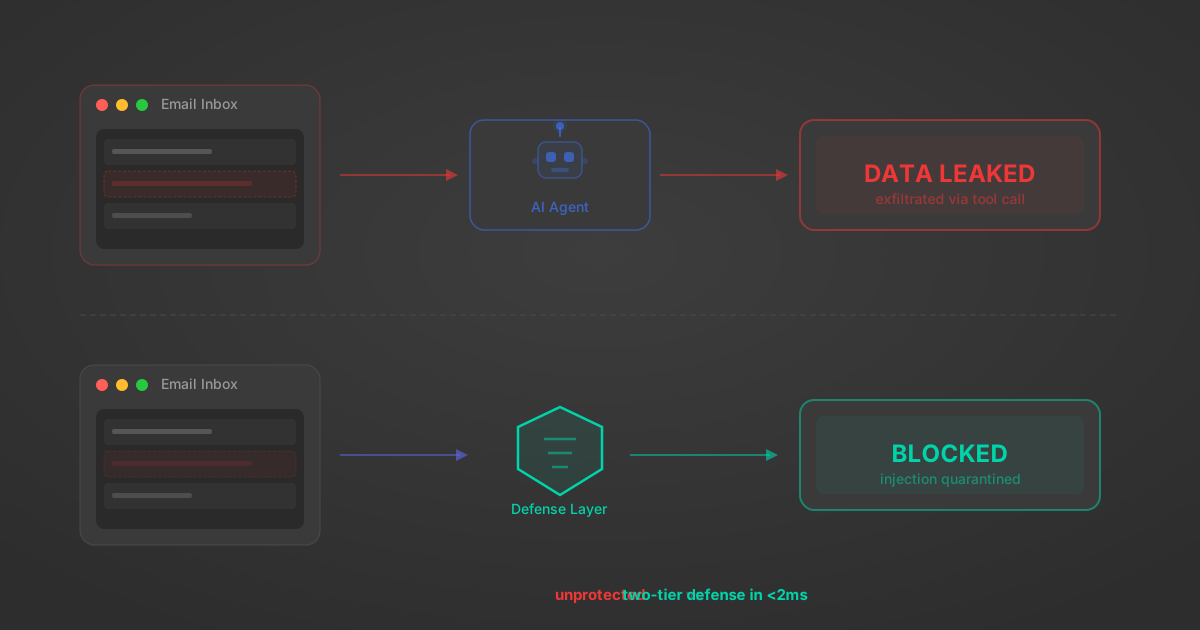
Indirect Prompt Injection Defense for MCP Tools: A Technical Guide
MCP tools that read emails, CRM records, and tickets are indirect prompt injection vectors. Here's how we built a two-tier defense that scans tool results in ~11ms.
12 min
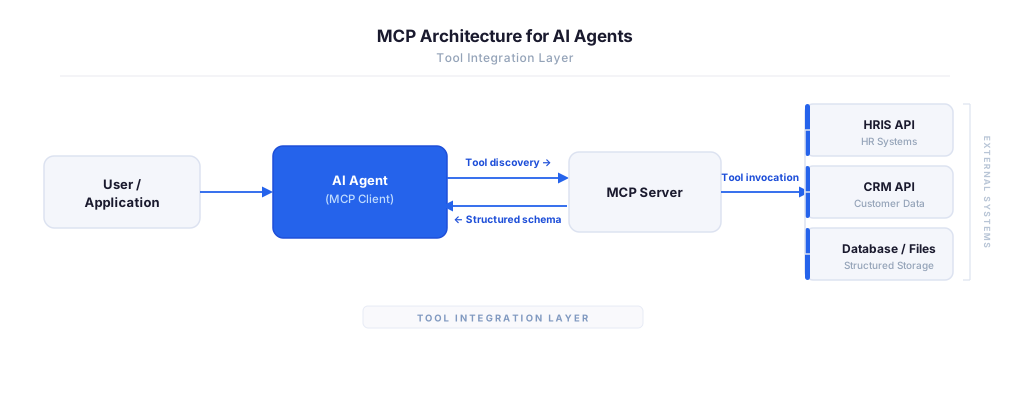
MCP vs A2A: Architecture, Security, and When to Use Each
MCP vs A2A: what each protocol standardizes, how they differ, their shared security risks including indirect prompt injection, and when to use one, both, or a hybrid architecture.
12 min
MCP vs API: What Hundreds of Connector Builds Taught Us
MCP wraps APIs, it doesn't replace them. After building hundreds of connectors that serve both, here's when each approach wins.
14 min read
InvGate Asset Management MCP Server FAQ
Does StackOne have a InvGate Asset Management MCP server?
InvGate Asset Management MCP server vs direct API integration — what's the difference?
How does InvGate Asset Management authentication work for AI agents?
origin_owner_id.Are InvGate Asset Management MCP tools vulnerable to prompt injection?
What is the context bloat of a InvGate Asset Management agent and how do I avoid it?
Can I limit which actions my InvGate Asset Management agent can access?
Can I create custom agent actions for my InvGate Asset Management MCP server?
When should I NOT use a InvGate Asset Management MCP server?
What AI frameworks and AI clients does the StackOne InvGate Asset Management MCP server support?
Put your AI agents to work
All the tools you need to build and scale AI agent integrations, with best-in-class connectivity, execution, and security.